Amid Immense Economic Uncertainty, Next Governor will 'Have to Do Some Fancy Footwork'
Caught between New York City and Philadelphia in a netherworld of dysfunction, misery, and the air-conditioned affectations of a suburban landed gentry, New Jersey suffers a unique set of troubles even in the best of circumstances, simultaneously beset by paroxysms of parochialism and the semi-illusion of civilization afforded by big urban center proximity.
It's probably no accident that the eccentric – putting it in the most generous way - Donald Trump owns a golf course here, and that NJ politicians in fact contributed substantially to the power concentration of their uncaged tormentor in-chief. Those offended by the sight of Chris Christie offended by the sight of Donald Trump likely forget their own complicity in furnishing Trump with tax abatements to build his casinos and extend the myth of himself beyond the forlorn shores of Atlantic City.
The same fat cats who forked Trump tax abatements so they could – presumably – sit ringside and watch Iron Mike Tyson demolish Micheal Spinks inside of one round, who grimly signed off on tax hikes perpetually saddling working-class New Jerseyans, at least still have The Donald to kick around. “See!” they – or their sons or grandsons who inherited their seats - say. “Look at the mess he created.” But the working class got wise to the game, leapfrogged the unctuous middlemen, and simply attached themselves to the strong man, who promptly went after the weakest among us. The problem, Trump rails, is not the long-demonized working stiff, fooled by the “Democrat” Party, but “illegal aliens,” and the woke agenda enabled by eggheads.
Confronted with the deflating fact that consumers pay 55% of the cost of Trump’s tariffs, the President’s MAGA followers are more inclined to discredit the source – Goldman Sachs. “Isn’t that a training ground for Democrat Governors from New Jersey? – or simply repackage this convenient talking point from the White House:
"The President and Administration's position has always been clear: while Americans may face a transition period from tariffs upending a broken status quo that has put America Last, the cost of tariffs will ultimately be borne by foreign exporters. Companies are already shifting and diversifying their supply chains in response to tariffs, including by onshoring production to the United States. Americans can rest assured that the Administration will continue to deliver economic relief from Joe Biden's inflation crisis while laying the groundwork for a long-term restoration of American Greatness." (Kush Desai).
What about the federal budget?
Money in there to put masked men – boots on the God damned ground – in democrat-run cities to kick ass, round up illegals and ship them to Alligator Alley. Plus, he’s got an ally who knows how to wield a chainsaw. Well, he did.
What about the rest of it?
What rest of it?
Well, priorities in the bill giving tax breaks to billionaires and (again) shifting costs to consumers, critically in the areas of energy, education, and healthcare; and, if you live in New Jersey, punching a gigantic hole in the federal portion of the state budget.
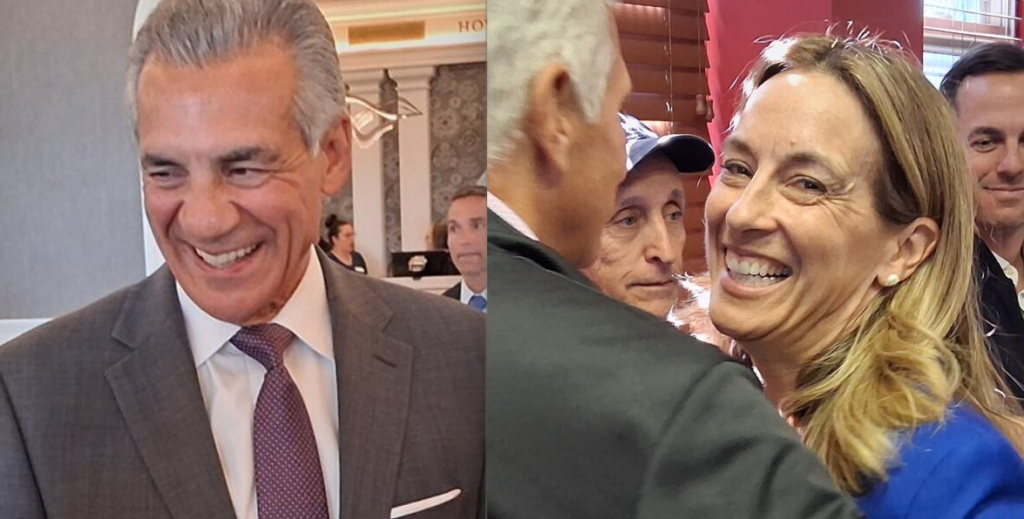
A tough helicopter pilot, disconnected from the political symbioses of an old boys network here, U.S. Rep. Mikie Sherrill – the Democratic nominee for Governor - would fight Trump, not be his lapdog, (while freezing utility rates for New Jerseyans to drive down homeowners’ overall costs, protecting union jobs against Trump’s doublespeak).
The most ardent allies of Sherrill would like to believe it’s that simple.
But here comes Republican nominee for Governor Jack Ciattarelli, backed by Trump, who does not come across like a MAGA lunatic but more like the guy you grew up with, played ball with, who strives to resist platitudes and talk plainly.
Last week, InsiderNJ sat in a diner booth with a senior citizen wearing a Navy baseball cap, the cap of a Navy veteran, who stared back, infuriated, at a question about whether he identifies with Sherrill. “Is that going to lower my property taxes?” the vet groused.
Ciattarelli talks about property taxes. He talks about the state budget under Democrats going from $35 billion to $60 billion. And he talks about solutions. He wants to overhaul the schools funding formula to follow the student not the zip code and expand school choice. He wants to empower energy sources across the board to make up for the blunders of the Murphy Administration, which bet the state’s energy future on wind. And, Ciattarelli says, he wants to extricate New Jersey from the Regional Greenhouse Gas Initiative (RGGI).
Sounds good. Sign me up. Right?
Again, the most impassioned backers of the GOP nominee can only wish it were that simple.
First of all, Ciatttarelli, like everyone else, must operate within a state within the larger framework of the country and the nation’s economy. People have their doubts on this front, as inflation persists and worsens, unemployment rises, consumers absorb the shift of costs from the President’s tariffs, and vulnerable communities faces limited – or no - access to Medicaid.
Trump ran on the economy in 2024.
And now, the Center Square Voters' Voice Poll, conducted by Noble Predictive Insights, which surveyed 2,565 registered voters from Oct. 2-6, 2025, found that 51% of voters disapproved or strongly disapproved of Trump's handling of the U.S. economy. About 47% of voters approve or strongly approve of Trump's handling of the economy. About 3% of voters said they weren't sure.
Republicans were more likely to view Trump's economic record favorably. About 80% of Republican voters said they approved of Trump's economy. However, Democrats and independents don't see it that way. Among Democrats, 83% disapprove. Among independents, 57% disapprove.
Income level also affected the results. People with more money were more likely to view Trump's handling of the economy positively. Among registered voters with less than $50,000 in household income, Trump's economic approval rating was 39%. Among voters with household incomes between $50,000 and $100,000, that approval rating climbed to 46%, while 59% of households earning more than $100,000 viewed Trump's handling of the economy favorably.
Worse: people don't need a poll to know it hurts.
As he navigates New Jersey on the campaign trail, Ciattarelli must acquiesce to the White House’s line about the future beneficial impact of Trump’s tariffs.
A day after a new Bureau of Labor Statistics jobs report showed meager post-President Donald Trump tariff job growth, the Republican gubernatorial nominee – on record in support of the tariffs, told InsiderNJ, “They’re not going to have the impact that people think. More than anything it’s a big negotiation.”
So far, not so good.
This week, as Trump ups the ante on a trade war with China, this from the BBC:
New US tariffs on imported kitchen cabinets, vanities, lumber, timber and certain upholstered furniture have come into effect. Under a proclamation signed by President Donald Trump last month, a 10% tariff on softwood lumber and timber imports will apply as of Tuesday. A 25% tariff will also apply to imported kitchen cabinets and vanities - rising to 50% on 1 January - and a 25% tariff on upholstered wooden furniture will increase to 30%, unless new trade agreements are reached.
Too tough to get over for Ciattarelli.
Point: Sherrill.
Right?
Well, the NJ Republican notes that Democrats and, in particular, Sherrill, want to blame Trump for the economy. For everything. But it was Murphy’s failed wind gambit, after all, that drove up utility costs here, and even the beleaguered Murphy says Sherrill’s promise to freeze utility costs makes no sense. The state doesn’t ultimately have the power to impose those controls.
Point: Ciattarelli.
But not so fast.
The Republican’s plan to overhaul the schools funding formula – supposedly his strong point - also lacks credibility. First of all, it would defy a Supreme Court ruling. Second, it would put the brakes on a fix implemented by state Senator Troy Singleton (D-7). Moreover, Ciattarelli’s plan would revisit the same strategy attempted by Christie, a politically shrewd operator, who couldn’t get it done. The current GOP nominee’s designs on landing a Republican majority in the legislature don’t look realistic, especially given the advantage of 850,000 registered Democrats over those affiliated with the Grand Old Party.
Ultimately Trump’s economy will prevail, Republicans argue.
And if it doesn't, they will always have Wildwood.
No one can read the economic future with certainty. Embroiled in trade wars – or trade skirmishes – worldwide, the United States find itself in an especially volatile economic situation.
But this is about New Jersey – not the planet.
Okay.
New Jersey.
Too many people. Not enough affordable housing. The enormous neighboring financial sector always creates the market incentive for contractors to build (and build!) luxury housing for commuters – not workers. Substantial portions of the state are protected and environmentally sensitive. Undevelopable. New public demands as a consequence of AI – and population - overburden the energy grid. Investments by the Murphy Administration in transportation – to complement federal funding of the Gateway Tunnel - and pension payments, merely contribute to the public perception of expanding government. Programs meant to defray costs for seniors like StayNJ and ANCHOR get lost in the cacophony or contribute to the appearance of government overreach.
Maybe.
Said an economist, looking at the bottom of an empty glass on a barstool beside InsiderNJ, not even paying attention to the governor’s race with less than a month remaining:
“The primary operating principle for any policy is you must pay for what you want and nobody wants to pay for all this. Yes, healthcare costs will rise for a lot of people – but there needs to be a longer term look at how you pay for it, without deviating from the core principle. It’s not just costs going up. The U.S. deficit increased by 8 percent in 2024 is unsustainable. Make the healthcare subsidies permanent but find a way to pay for them. People don’t have confidence in currency. They put it into metals. This is what happens when you debase a currency by not paying for things.”
At the federal level and internationally, Trump – in political retaliation mode – creates more volatility and uncertainty. At the state level, lawmakers angle to get a bead on the FY2027 budget, trying to figure out how to negotiate cuts to education and energy – the impact to public pensions and, yes, general healthcare, not to mention the implications of the federal shutdown (This just in!).
Marc Pfeiffer, Faculty Researcher, Bloustein Local Government, Center for Urban Policy Research at the Edward J. Bloustein School of Planning and Public Policy, told InsiderNJ - whoever the next governor is, given all the uncertainty, an economy with the potential to lapse into a recession, New Jersey's own ages old troubles augmented, “That person will have to do some fancy footwork.”
For all the fervor, for all the attempts by candidates in both parties to offer partial solutions, talk around intractable problems, or try to sound rational and reasonable, a source, an economist by trade, speaking on condition of anonymity, said Trump singlehandedly contributes the most uncertainty, and the most volatility. “He," said the source, referring to the President with inevitable NJ ties, "is the most crucial element of this problem."
Was it Jersey? Was it Trump? Was it Trump in Jersey? Or Jersey in Trump?
Would the contest for governor merely lengthen the chain or break it?