
I Don’t Know where the Pain Began, and the Anger – but I know Where it Ends
Maybe it began in Wyoming, in Rawlins, when a van went off the road in the rain. Law enforcement responded to the scene. They found 17 undocumented workers in the van. Some of them tried to flee. They didn’t get far in that stark western downtown. Sheriff’s deputies rounded them up with ease. But one of the 17 couldn’t go anywhere. He had suffered a broken neck in the accident. He lay motionless in the street.
The Sheriff’s Office called a medivac for him. The helicopter landed, retrieved and packed the victim, and departed, bound for Casper. The deputies took the other sixteen to a room in a public building and had them sit against the wall for processing.
All the people in that van, who had hoped to come to this country, would get turned over to Immigration and Customs Enforcement, and taken back to Guerrero, Mexico. But someone who was there that day couldn’t stop thinking about the man in the street with the broken neck, who wouldn’t go back with the rest of them.
That night, that person thinking about the wounded man drove to Casper and went to the hospital and found the dark room with the man inside. Lorenzo was his name. He would never feel anything again below the neck, the nurse said. He was trying to get to his family, who had already made the trip to Pennsylvania. They were fruit or vegetable pickers. Now he lay in that dark room, with the mountains just outside. He couldn’t see them. He couldn’t see anything except the ceiling. The person from Rawlins tried to talk to him, not knowing if Lorenzo could hear. He held his hand, which he couldn’t feel.
Or maybe it was another time when they went to an apartment where a woman had terminal cancer. They were afraid to open the door inside, because they weren’t here legally, but the pain had become unbearable. The victim lay in bed in the middle of a tiny apartment. Her husband had gotten picked up and extradited to their country of origin. Now she was here without her partner, with a younger sister and their mother and her own baby child, and she was dying. The cancer had extended from her back to her brain, everywhere. They had to figure out how to move her while causing the least amount of agitation. The slightest motion would create sudden additional agony.
Someone tried to get her attention focused elsewhere - on a song maybe. Surely, a song they could sing as they carried her down the steep and rickety stairs to the street.
“Do you like any songs?”
“Gringo Songs? None.”
“Oh, come on. You must like one Gringo song.”
“Para nada,” through gritted teeth. Hostile.
“Not one?”
She relented.
“Guns and Roses.”
“Ah, Sweet Child of Mine. Sure. “She’s got a smile and it seems to me…”
“NO!” She spat, offended, and not just by the bad singing voice, and by now she grimaced with new depths of pain.
She added, with great difficulty, “Welcome to the Jungle.”
That’s the one song she liked.
So, they sang “Welcome to the Jungle” together.
“Do you know where you are? You’re in the jungle, baby.”
She loved that line. Singing that line through unendurable suffering made her laugh. She couldn’t laugh too much. She tried to control it. But she couldn’t.
“Do you know where you are?”
“The jungle, baby.”
She laughed the tough and ironic laugh of one who has trained herself to finally fearlessly face death.
Maybe it was the death, after all, of Edilberto Caicedo, in Kearny.
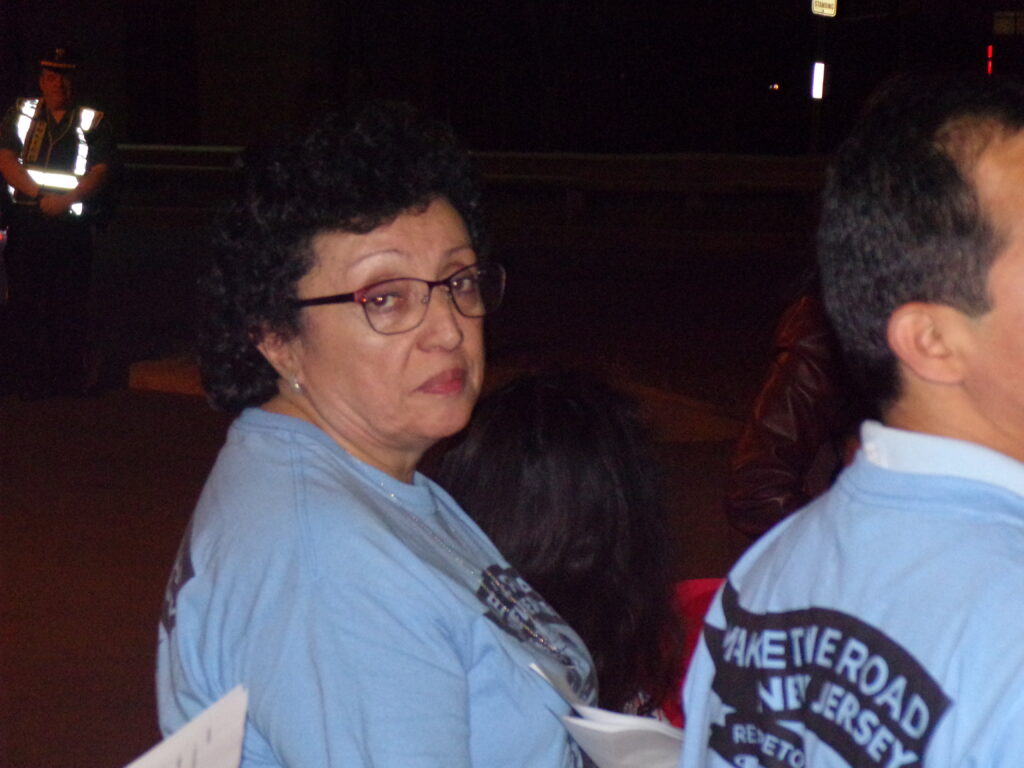
If you're illegal in this country, you can't get an organ if you need one, but they will take your organ if you die, said Janet Caicedo (pictured), choking back tears in a parking lot outside the warehouse where her brother died.
This was in 2019.
"He told me, 'If something happens to me, I want to be a donor,'" Caicedo recalled.
A forklift operator who worked for an unlicensed temp agency, Mr. Caicedo died on the job. "Today, I received a letter saying four more lives were saved because of his organs," said Janet Caicedo.
"He was so generous," she added of her brother, a native of Bogota, Colombia, who Make the Road New Jersey activists say was exploited, like thousands of other undocumented workers, by companies making profit on the backs of people.
"We are here to demand that the State of New Jersey investigate temp agency hiring practices," Janet Caicedo said. "We demand laws that protect the rights of temp workers. And we demand that CVS and American Eagle cut ties with T.I. Logistics."
Or maybe it happened years ago, when one’s own father, immigrant to this country, pumping gas for a living, military veteran, Cold War veteran, Cuban Missile Crisis, 1962, heard the hateful words across a cow pasture, “Why don’t you go back where you came from?” One would never have heard the story of that encounter from the man who received those words. That man would never have thought to complain. That man would never have had a moment to reflect on those words, because he worked too hard to ever even allow them to enter his mind. He was too far removed from that kind of narrowness. He would never have felt hurt from such a remark. Someone else heard it, though, and held it, someone who wasn’t as tough, or hard, or as resilient from all the times the older man had weathered alone: child abuse victim, runaway, sailor, back against the wall in the military while the others hurled the same prejudices and he had to fight with his fists on the deck of the ship. Such a man learns to survive.
Maybe it was then.
Maybe.
Or maybe it was the time his girlfriend, herself an immigrant, who came here because the government in South America murdered her brother, a student demonstrator, confessed her lack of trust. Her brother had organized against the military dictatorship, nonviolently, and the military killed him in the street. Then they put a picture in the newspaper of the dead boy with a gun in his hands, as if he had been the perpetrator of violence.
Or maybe it was when his girlfriend watched the tanks turn the corner on her block, and all the men lying in the street, and the soldiers came in with grease guns and took her grandmother away, in the days following the coup. Or maybe it was the time an undocumented worker, scared, alone, asked her for a ride because the worker heard she spoke Spanish, and his girlfriend later told of him of the poverty she witnessed when she took the worker to a little flat, up a row of stairs, behind a wall of hanging laundry. His girlfriend went to church right after that, shaken, feeling helpless and wanting to do something. She knelt and wept.
Or maybe it was when he saw his uncle in a prison cell, in Atlanta, and he was a little boy then, and his uncle walked in, wearing orange prison scrubs. The boy was playing on the floor of the cafeteria and chipped up a piece of tile. The man, the prisoner, took the boy in his arms and whispered, tough, undefeated, defiant, eyes twinkling, “Don’t show them our escape route.”
Or maybe it was when he heard about a former defense minister of a foreign country murdered by a car bomb in Sheridan Circle, Washington, D.C., which also took the life of a young woman from Passaic, New Jersey, and the fact that the men who murdered those two people, ultimately got away.
Or maybe.
Or maybe
Or maybe.
Or maybe.
“Fuck that,” said a man in a baseball cap, you don't have to guess at the one word printed on it, in bold letters, a man in a position of authority, in a little town, somewhere in America, when asked to consider the needs of people who might speak only Spanish. “Illegal aliens,” he calls them, or simply, “aliens,” in the conformity of language exercised by the President, reinforcing his own impoverished, ghettoized confines, as if the formations of a private golf course might encompass reality, and masked men with guns accompany their dream, for protection.
New Jersey can clutter the mind. The parochial little towns with their hard, little prejudiced edges. Can we really make ourselves so small as to live in fear, never to see the great horizons, with clarity – and the mountains? The distance lends perspective, to better see the toughness and terrain of Jersey.
Head of the canine unit, controlling his dog, the sheriff’s deputy told him, with genuine compassion, all those years ago, as he eyed the Mexicans propped against the wall preparing for deportation, “Imagine how afraid they are right now.” They got to go home, those sixteen, leaving one behind. Wyoming made life clearer sometimes, that spare and rugged high country, where a broken man, who’s dead, once tried to reach his family, and someone now still tries to reach somebody, reaching for more than lifeless hands.