
What if This Election were a Battle in the World of Ancient Rome?
Political campaigns are strategic operations. Careful decisions must be weighed and balanced, and then the best laid plans make contact with reality, and the campaigns—and the candidates especially—must deal with the fallout, assess, and regroup. Good campaigns are like chess games, where two opponents have agreed to act within certain parameters, respect certain rules, and position themselves in the best way to score a win at the ballot box.
With sophisticated campaign arrangements, they can take on some aspects of a general’s headquarters. Campaign managers serve as the primary adjutants, with consultants, connections made from other campaigns or organizations, patronage courted from allies, canvasers on the ground pushing their Get Out The Vote efforts, media personnel gathering intelligence and distributing information selectively and strategically, and a host of other moving parts which (more or less) follow a hierarchical command structure. Candidates themselves liken their endeavors to strapping on a helmet and going into the fray, where the battlefield is public approval, the fortress to capture is Trenton, and the contest—with all their carefully laid preparations, plans, snares, and expenditure of time and treasure—swings into action on Election Day.
Every district can be seen as a skirmish ground. Some such districts, whether a city, suburb, or even county, are not worth using limited resources and personnel, while others may be in play and make a critical difference in the bigger picture. Secure areas might be trusted for support, but nevertheless cannot be ignored, or their opponent will make good on the neglect and try to exploit or disrupt the rearguard.
In some respects, the Sherrill and Ciattarelli campaigns have mirrored such contests. Sherrill herself is a veteran, a naval officer and pilot, and is familiar with running a team under pressure in those circumstances. Ciattarelli has served as an assemblyman and led a potent gubernatorial effort, no stranger to campaign operations himself. The stakes are not life-threatening as they would be in a military campaign, obviously, and so long as that remains the case, there is a relatively healthy and free arena of civics. But certain military commanders can offer some parallels to the campaign approaches that Ciattarelli and Sherrill appear to have advanced.
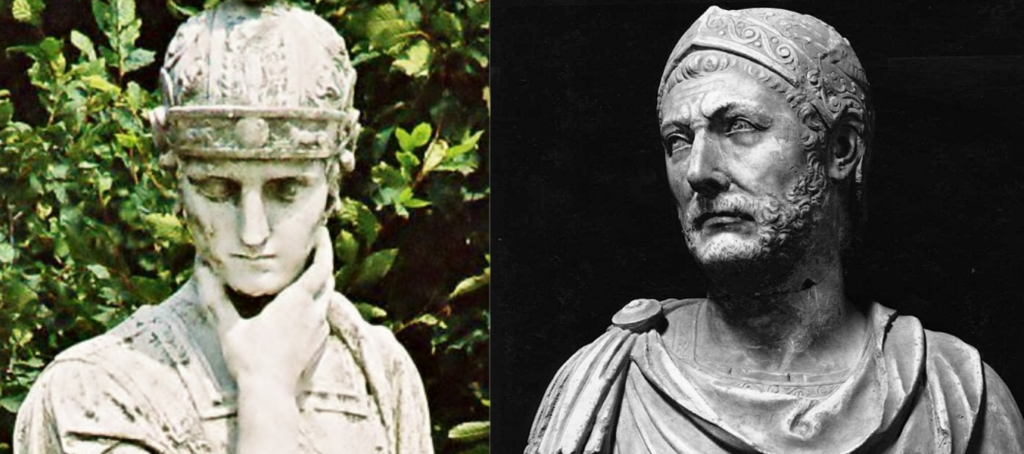
Quintus Fabius Maximus, a multi-term Roman consul, had ascended through the ranks of the civil and military hierarchy during his career, waging successful campaigns against neighboring Italian powers which threatened the Roman Republic. Sherrill’s campaign, herself a multi-term congresswoman and veteran, has the full support of her party establishment and can be viewed as defending the Democratic majority in Trenton from a Republican attack by a battle-tested opponent in Jack Ciattarelli. The second contest between Ciattarelli and a Democratic opponent, where the Republican nearly overthrew the governor in his bid for re-election in 2021, Rome and Carthage had faced off for the second time when Fabius was charged with defending the city from Hannibal.
Jack Ciattarelli has a strong personality, a sort of magnetism that has drawn in supporters unhappy with the status quo, with eight-years of Democratic leadership. Ciattarelli was able to marshal his forces and handily suppress challengers in the leadup to the primary. He had been carrying out a long campaign as well, as Hannibal had taken his time, built a coalition of allies in Iberia (Spain), and crossed over into Gaul (France), and made a daring passage over the Alps.
The Alps are an obstacle, undeniably. The greatest aspect of his daring strategy was to take the bold step by crossing the mountains and descend on Rome from the north instead of the south, closer to his home base in Carthage. The mighty mountains dominate all aspects of the landscape and battlefields and cannot be ignored. The Alps, of course, are manifested as Trump, both Ciattarelli’s great strength and great liability. By winning Trump’s endorsement over the more vociferously MAGA candidates like Bill Spadea (and Hirsch Singh before him), he was able to secure the resources and support needed to propel himself into the clash. The Alps also cost Hannibal dearly, as he lost all of his war elephants during the crossing. It is no secret that Trump is a divisive and polarizing figure, especially in New Jersey. Sherrill and the Democrats have been framing Ciattarelli as an extension of Donald Trump, who would bring dangerous and destructive MAGA policies to the Garden State and obediently carry out the president’s wishes, whatever they might be. Sherrill, like Fabius, has also been playing it safe. Like Fabius, she has received frustrated criticism from less-moderate elements in the party, demanding a more bold and strident approach.
Thus far, Sherrill has stuck firmly to the middle-of-the-road to appeal to a broad base of New Jerseyans primarily worried about economic issues. As Fabius sought to deny the formidable Hannibal a head-on clash whenever possible, Sherrill kept her messaging focused on relatively non-inflammatory issues during their first debate: affordability, education, housing. Ciattarelli fought a similar campaign, careful to avoid dipping too far into the perilous tarpits of the MAGAverse that could ensnare him in New Jersey, while still offering nuts-and-bolts-based praise for the president’s hyper-partisan “Big Beautiful Bill” which passed with zero Democratic support and two Republicans dissenting in congress.
Fabian was able to hold off Hannibal in the end, making use of superior Roman numbers which were judiciously employed to limit waste and a home-field advantage. Sherrill must court the Democratic base and garner as many allies among moderate, unaffiliated voters and secure the grudging support of the progressive wing—the Baraka and Fulop acolytes—to make the most of the Democrats’ near-million advantage in registered voters compared to Republicans if she will continue Democratic executive leadership in Trenton next year. Ciattarelli, with his strong, resonant messaging, appealing charisma and personal touch, it could be argued, never really stopped campaigning after his 2021 defeat, and as the Carthaginians had been bested in their first bout with Rome, the second contest would prove more dramatic and decisive. It would shape the balance of power in the long-run, and if Sherrill is able to come out on top on election day, then it would repudiate the MAGA brand yet again in New Jersey. Historically, Hannibal outlasted Fabius, but he never took Rome. Jack Ciattarelli, regardless of the electoral outcome in November, will remain a key player in New Jersey power politics for the foreseeable future and Democrats would be wise to spar carefully with the seasoned veteran on the campaign path. The 2025 gubernatorial election, looking over the battered walls of Trenton power, is a contest that is Sherrill’s to defend from within, and Jack’s to conquer from without.