
Due Process Is an American Right, Even at Delaney Hall
BY GUY CITRON
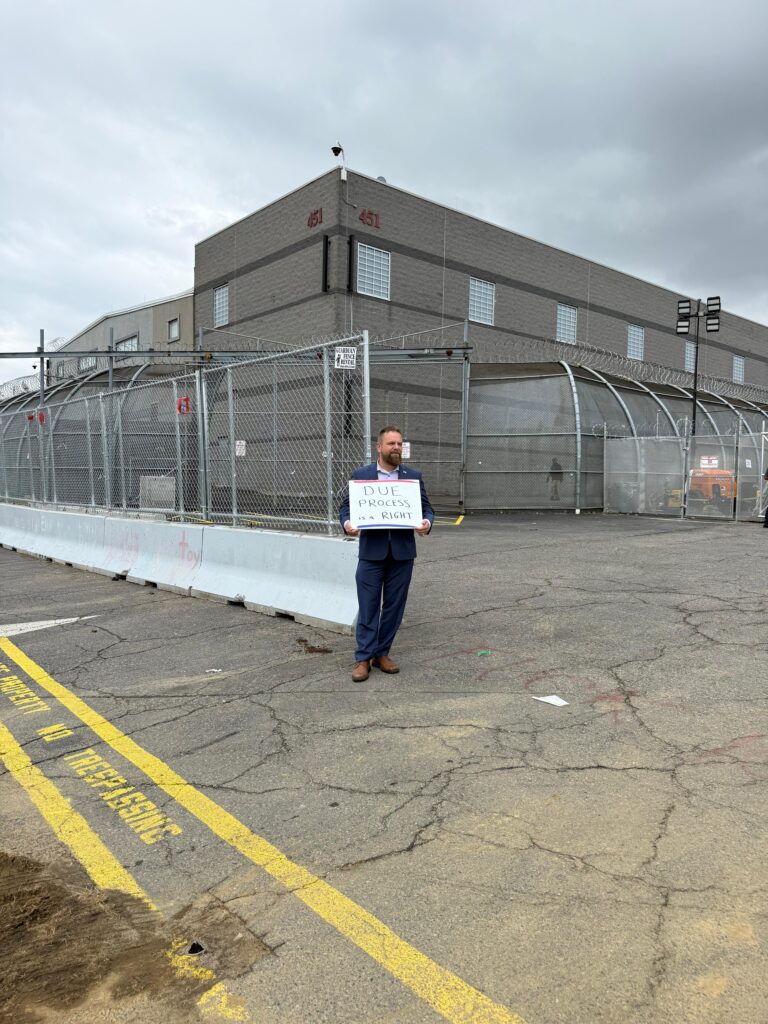
I held a sign that read, "Due process is a right," outside of Delaney Hall.
It was the Sunday morning after July 4th, and the place was relatively quiet, save for the visitors who had come to see their detained loved ones. Their stories were impossible to ignore.
One woman was a post office supervisor, and an American citizen. She told me her husband had been detained there for several months. When she arrived to visit him, his "unit" had apparently been changed overnight, so her visitation request no longer matched. At first, she was denied access because of this apparent administrative error. Later, she was allowed in for what I can only imagine were a few precious minutes, since visitors seemed to be called by units in shifts.
Another young woman showed me the now-viral video of ICE officers smashing the window of her car before taking her husband into custody. She, too, is an American citizen. Their two children had come with her to visit their father. She told me her young daughter, who looked to be about the same age as my own son, has been struggling with severe mental health issues since her father’s detention. She has even spoken about wanting to kill herself.
There was also a man who had come to visit a friend. He spoke enough English to communicate, but there appeared to be a problem with his friend's prison identification. He was looking for "a Lopez." He was told there were many inside. After waiting for nearly an hour, he was informed that his friend had either been released or transferred to another facility. The man had arrived by bus and had likely spent hours getting there, only to leave without ever learning what had happened to the person he came to see.
Visitors described arbitrary rule changes, difficulty navigating the system, and retaliation against friends and family who complained too much. I tried my best to listen and observe throughout the morning while masked ICE agents drove through the facility gates in vehicles without visible license plates. Nearby, volunteers gave visitors diapers and other supplies for loved ones inside.
When I asked a GEO Group employee standing outside what his name was, he simply replied, "My name is Officer." That brief exchange stayed with me. It seemed to capture everything I had witnessed throughout the morning. Whether every story I heard could be proven misses the point.
The authority to detain another human being carries an equally extraordinary responsibility to act according to law. People should not be left wondering where their loved ones have gone. Rules should not appear to change without explanation. As John Adams wrote, ours is meant to be "a government of laws, and not of men." No public official, no private contractor, and no institution stands above that principle.
That is not a liberal value or a conservative value. That is an American value.
The Fifth Amendment guarantees that no person shall be deprived of life, liberty, or property without due process of law. That guarantee rests on one of the oldest principles of our legal tradition: innocence is presumed until guilt is proven. Government does not acquire the authority to deprive a person of liberty simply because it suspects wrongdoing. It must follow fair procedures, prove its case, and remain subject to the law it is sworn to uphold.
As we celebrate the 250th anniversary of the United States, it is worth asking whether we are still living up to that promise. Patriotism is not measured by flags and fireworks. Love of country is measured by whether we continue to defend the constitutional principles that have defined freedom since our founding. Due process is one of those principles. If it does not protect people when it is inconvenient, then we have confused patriotism with performance, and liberty with permission.