
Governor Sherrill's Ponders Data Center "Faustian Bargain'
BY COLLEEN O'DEA
New Jersey’s U.S. senators both voted last Thursday against a divisive bill that seeks to speed permitting for new energy projects and require data centers to pay for the power they use, while also weakening environmental protections.
Gov. Mikie Sherrill’s position on the bill, which still needs to pass the House, where its future is uncertain, is less clear. Her office declined to comment on it.
Energy policy has been a priority of hers since taking office 11 months ago. New Jersey needs to increase supply in order to blunt electricity increases – last year, power bills jumped by about 20%. But the state also has strong environmental laws and a population that values the clean water and open spaces in the most densely populated state in the nation.
The Bipartisan American Affordability and Jobs Act of 2026 (BAAJA) combines some clean energy provisions and the promise of jobs with reduced environmental protections. It has pitted the Citizens Climate Lobby and AFL-CIO against the Sierra Club and NAACP. It divided the Democratic caucus, with 14 Democrats joining the Republican majority Thursday to pass the bill 62-33 and send it to the House of Representatives. Only two Republicans opposed the bill. If sent to his desk, President Trump likely would sign it. A policy statement from the White House touted a number of provisions of the bill, saying it would “remove major obstacles to building the infrastructure we need in this country.”
The New Jersey State Chamber of Commerce and four regional chambers signed on to the U.S. Chamber of Commerce’s statement of support for quick action on the bill: “Permitting reform is ultimately about delivering results. When needed investments are delayed, families and businesses face higher costs, longer wait times, and fewer opportunities. Communities wait longer for congestion relief, the broadband connections needed to support work, education, health care, and entrepreneurship, improved access to clean water, and the energy infrastructure needed to meet growing demand. A more efficient permitting process can help deliver these benefits sooner by reducing unnecessary delays and improving certainty while maintaining strong environmental protections and opportunities for community engagement.”
But many environmental organizations disagree and oppose some or all of the bill’s provisions to weaken environmental protections.
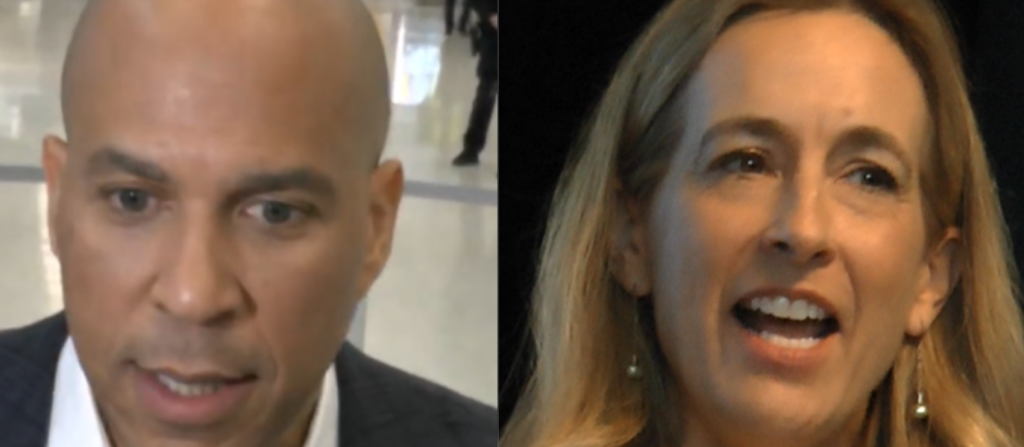
Doug O’Malley, director of Environment New Jersey, called it a “Faustian bargain” that the nation should not accept and he praised Sens. Cory Booker and Andy Kim, both Democrats, for voting against the measure.
“This would be a really bad deal for New Jersey and the country,” O’Malley said. “We would be sacrificing the natural environment for the promise of clean energy but there would be a ton of rollbacks of permitting protections for fossil fuel projects.”
The bill would weaken a number of environmental protection laws, including the Clean Water Act, making it harder for groups to stop projects that could harm the environment. One such project is the Northeast Supply Enhancement Project or NESE, a proposed expansion of a pipeline carrying natural gas from Pennsylvania through New Jersey to New York and that would require the installation of six miles of pipeline through the Raritan Bay. The project is back before the state Department of Environmental Protection after a federal appeals court vacated state approvals for it two months ago.
“It’s a false choice,” O’Malley said of the bill. “We think you don’t think you have to sacrifice environmental protections for clean energy.”
While the bill would require data center developers to cover the costs of the electricity they consume, there would still be “huge environmental impacts,” including in water usage that cools the high-capacity computers needed for artificial intelligence processes, O’Malley said.
In voting no, both Booker and Kim said that while they support the bill’s clean energy goals, it does not do enough to stop potential abuses of a new permitting system by Trump, including those involving new immigration detention systems.
"I believe the climate crisis demands urgent action, and smart permitting reform can unleash a generation of new good-paying union jobs and new technology,” Kim said in a statement. “I voted earlier in the process to allow a debate and amendment process that could improve the bill before final passage. Unfortunately, those improvements, which would rein in the worst impulses of the Trump Administration, were not made, and the potential consequences for New Jersey are unacceptable.”
Booker’s statement explaining his “no” vote went further.
"I respect the work done on this bill with the goal of accelerating clean energy and building out our grid, but I do not believe it meets the mandate voters have charged us with to put a check on the corruption, chaos and cruelty of Trump's administration,” he said. “I am particularly concerned that the legislation would eliminate the courts’ authority to block the administration’s illegal projects, including ICE detention centers.”
As the Senate considered the bill, Kim had proposed several amendments, including one that would allow local communities to challenge immigration facilities that skipped environmental review. One of those is in Roxbury, where federal officials recently signed a contract to advance the conversion of a warehouse to an Immigration and Customs Enforcement detention facility despite having agreed to halt work at the site until they conduct required environmental reviews in response to a lawsuit filed by the state and the township.
Sherrill, who opposes the ICE plans for Roxbury, has signed legislation and taken a number of other steps meant to increase the state’s energy supply and prevent further electricity increases due to data center development, though she has not gone as far as New York Gov. Kathy Hochul, who in July put in place a moratorium on the development of new large scale data centers. Two polls found New Jerseyans oppose the siting of data centers in their communities and some 110 municipalities in the state have passed ordinances banning them. Yet Attorney General Jennifer Davenport was not among the 17 attorneys general who sent a letter to Senate leaders earlier this month in opposition to the permitting bill.
New Jersey’s senators’ opposition to the bill was clear.
“The bill would weaken bedrock environmental laws and strip away important tribal sovereignty protections,” Booker said. “We should fight for a better deal that centers communities and helps us build out a clean energy future and lower costs for working people, without sacrificing environmental safeguards that have protected us from this current lawless Administration."
The fate of BAAJA’s in the House is unclear. O’Malley said opponents would be contacting the state’s House delegation to express their feelings soon.