
Latina Civic Action Panel Calls for Support to Increase Latina Voices in Politics
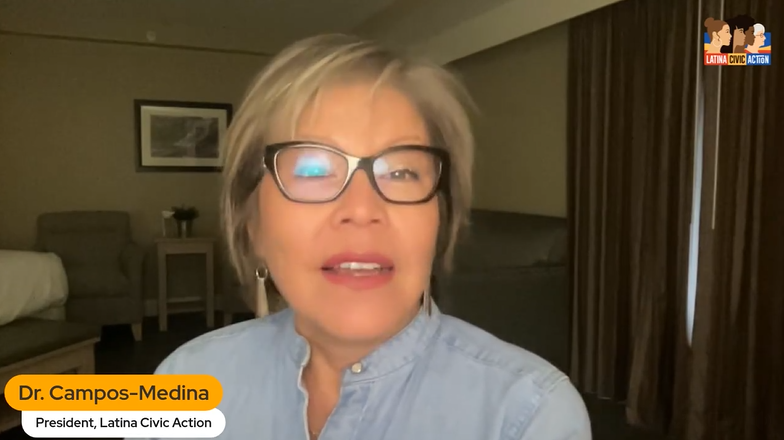
Latinas make up an increasingly large part of New Jersey society, but still occupy a disproportionate measure of elected leaders, and should be supported not just by their own communities, but by the broader voting base, and steps need to be taken to breakdown gatekeeping barriers so these women can make their case equitably. This was the overall message from a panel Wednesday, hosted by Latina Civic Action. The discussion was opened by Dr. Patricia Campos-Medina, President of Latina Civic Action who also ran for US Senate in the 2024 Democratic primary. She was joined by Aileen Merino, Policy Director of STONO Public Affairs; Chelsea Hill, Director of Data with the Eagleton Institute of Politics, Center for American Women and Politics; Assemblywoman Dr. Carmen Morales (D, LD-34); Silvia Catalan-Culnan, Mount Laurel Councilwoman; and Christina Schratz, Passaic Public School Board Member and Democratic candidate for Passaic County Commissioner.
Campos-Medina highlighted a report on the status of Latinas in New Jersey last year, which she described as “not just timely, but essential” for Latina stakeholders. “It acknowledges the increasing influence and presence of Latina leaders in our communities, while also highlighting the deepest structural inequalities that continue to restrict our full participation and representation in New Jersey government and politics. This report makes one thing clear: progress is not accidental. It requires intentional investment and deliberate support to ensure that Latina voices are not just present, but powerful at every level of decision making. Latina Civic Action and our board women, who are powerhouses in different fields, are committed to use data-driven advocacy to move the needle forward in representation for Latinas.”
She continued, “We believe it is our responsibility as leaders in our fields to invest in our talents and resources to build a pipeline of Latina leaders ready to step up into leadership.”
She referred to her last foray into elected politics, where she competed against then-US Rep. Andy Kim and activist Lawrence Hamm for the Democratic nomination to succeed Sen. Robert Menendez. “Having recently had the opportunity to run for United States Senate here in New Jersey, where I finished second place, I saw firsthand how political gatekeeping operates and who leaves us behind. Despite my decades of experience in labor advocacy and public policy, I face the same barriers many young Latina candidates encounter: skepticism and doubt, not just from insiders, but from those who depend on our skills and knowledge to advance key legislative priorities on key policy issues in New Jersey. Latinas experience limited access to institutional support, money, and systemic doubts about whether we are viable as candidates for public office. But one thing I learned during my campaign is that people in New Jersey do think we are viable. New Jersey voters are yearning for authentic leadership, and they want to vote for people like us.”
Campos-Medina hailed Latinas’ love for New Jersey and their American values, saying that Latina leaders bring a “special sauce” of their own. “We are authentic because we are proud of our ethnic identity, but we are even more proud of being Americans—Puerto Ricans, Cubans, Dominicans, Ecuadorians, whatever we are—we are proud of our ethnic and culture, but we're also proud of being Jersey girls.”
The discussion celebrated the election of CD-9’s Nellie Pou to the US House of Representatives in 2024. Pou is the first Latina to be part of New Jersey’s congressional delegation and, as such, has raised the visibility of Latinas in the legislature by breaking that ground.
“Six Latinas have run as major party candidates for Congress in New Jersey between 2002-2024,” Hill said during her slideshow presentation. “All but Pou were unsuccessful. As one of the six states in the nation with two or fewer statewide elected executive offices, New Jersey does not present many opportunities for underrepresented communities to be elected statewide. A total of four women, one as governor and three as lieutenant governor, have served at the statewide elected executive level in New Jersey's history, and none have been Latinas. Nationally there are six: five Democrat, one Republican, Latinas currently serving in statewide elected executive offices. These Latinas make up 1.9% of the 310 current statewide elected executives and 6.4% of the 94 women serving in these offices. New Jersey joins 46 states that have no Latinas currently serving at this level. In the last 25 years, only one Latina has run as a major party candidate for statewide elected executive office in New Jersey. In 2013 Milly Silva ran unsuccessfully for lieutenant governor. As gubernatorial candidates in New Jersey pick their running mates, we'll be watching closely to see which names emerge as potential Lieutenant Governor candidates for the gubernatorial election this year.”
Hill also noted that there are no Latina party chairs in New Jersey at this time. She said that to improve Latina representation, New Jerseyans should support programs that recruit and support Latina candidates, that seek out potential candidates and create support networks for them. Support, she said, would manifest in various ways, including organizational and financial resources, but should draw on the broader community, and not just their own.
Echoing Campos-Medina, Hill called for action to address and oppose political gatekeeping. “These parties must make concerted efforts to recruit Latina candidates, and work should also be done to demystify the process and dismantle barriers of entry. The parties need to make intentional efforts to recruit and run Latinas in winnable races.”
Assemblywoman Morales, the first Puerto Rican woman in the assembly from Essex County, said that she was inspired by her students and was committed to showing representation for their communities in elected leadership. She said she made a point of sharing policies in multiple languages to her constituents and emphasized the importance of “normalizing” the presence of Latinas in politics, and the political realm itself.
“In my early 20s I worked at a non-profit in the city of Newark called the North Ward Center. I was a preschool teacher there and the leader of this organization was Steve Adubato. Many political figures in the state of New Jersey, and especially Essex County, know who Steve Adubato was, and that was my beginning introduction into the political world. I would say these are my grassroots organizations that really introduced me to what it meant to be civically engaged in our community and I was inspired by it. I knocked on doors. I helped people get registered to vote. I listened to people about the issues that were impacting the community and from there, because I am a person that loves to help people, I immediately was engaged. Being part of this organization that not only saw the qualities of what a great leader and an elected official does, but we helped these elected officials to get into their offices. That was my beginning introduction to the political world.”
A resident of Belleville, Morales said she was approached by the Democratic Party to run in district 34 during redistricting. She was hesitant at first. “This report really touched upon many reasons as to why women don't want to be in these leadership roles,” she said. “My dissertation had to do with the under-representation of women of color in high school leadership roles, specifically principals. What I found, as well as what this report found, was that women don't usually strive for these high leadership roles unless they feel they're 100% ready for these leadership roles, many times because we are so hesitant to be approached or to even go for it, we stop ourselves. Knowing that I was involved in my study, knowing that I was approached to run for office, and the other biggest thing—knowing that my students were looking at me—representation matters, and that was the turning point for me, knowing that my students were going to see themselves in me when I say ‘yes’ to running for office.”
Catalan-Culnan, the first Hispanic councilwoman to serve in Mount Laurel, spoke about growing up in Colombia and how that shaped her experience which she brought into her adult life in the US. She and her mother started a school to teach people literacy and traveled to rural communities without public transport. As a youth, she helped people apply for educational opportunities, aspiring to be a social worker. “As a 14 year old I was starting to be in front of a group of young leaders in these communities and start telling them my story.” She continued, “I believe I am strong, and I bring a lot of value to my community because of who I am. Again, it has challenges because of some people, especially in this community where it's 68% white, I would say that most people believe that, I guess, a leader looks like a white, older person. But I represent the Latino community, and once again, this comes with some issues when it comes to the way people look at you. But I am fortunate to be where I am and keep working and keep connecting with the community.”
Christina Schratz said going from a school board to a county-wide race, as she seeks a commissioner’s office in Passaic County, has been “a little bit intimidating” because of the broader audience. “It's a larger group of voters, so you want to ensure that you're connecting to each individual group, and for them to see who you are, an individual as well as an elected official. So I thank God, I kept it simple. I kept myself humble. I stayed true to myself. I remember every single word from my mentors, because it was very important to have them.”
She noted that she has been an elected official for the last eight years and continues to learn from her valued mentors. “When it came to running for county, I made sure that I kept myself back to basics, you know, making myself known as to whom I am, making each individual know that I'm here to listen first and to continue to grow as a Democratic leader and the Democratic Party. So yes, there are some hurdles. There continues to be, like I mentioned, but it's all good at the end of the day. We all learn from this process, and if you go in it right, motivated, and wanting to do more for your towns and the municipalities you serve, you're going to do well. There's always going to be that fear, but, again, we all need that support system to continue to allow us to motivate in that safe environment that we are doing the right thing once we say yes, I'm going to run for that seat.”
Running for office becomes a consuming experience, and she said it requires her to bring out all of who she is, continuing to connect with people. “I kind of say, this what you really want? Is this what you really want? At the end of the day this is going to be 100% of your time, phone calls, meetings, events, webinars, seminars, meet and greets. You have to love what you do. If you love what you do, and you have that passion for it, there's going to be fear, but then you turn to your support group. Your support group is that system that's going to lead that way for you to do well. You're going to have that person that you can call, or kind of have that pep talk. I'm going to have an event today. What are the talks that I should bring up? What should I address to the crowd? How do I connect with the crowd? How do I present myself? I need feedback. Those are the conversations and motivations that I look to, and that has allowed me to go into the position I am today, leading into as a candidate for the county.”
Some of the strategies discussed to help increase the presence of Latinas in politics were creating mentorship systems, or “sister circles” to help candidates and potential candidates. They also stressed the need for expanding recruitment into Latino communities and getting women on board, taking a hard look at the realities of political gatekeeping within the major political parties, and making “pathways” so that the financial and organizational support from these bases can be translated into wins. Sharing personal experiences, attending meetings, building networks, and supporting other Latina candidates would be of benefit for Latina candidates themselves.
Latina Civic Action wrapped up the discussion with the notion that representation in politics is not “accidental,” as Campos-Medina said, but is the product of a sustained, deliberate effort on the part of engaged and committed Latina leaders and their supporters, eager to bring their experiences to the public at large.