
Mejia Spars with Musella at Parsippany Town Hall
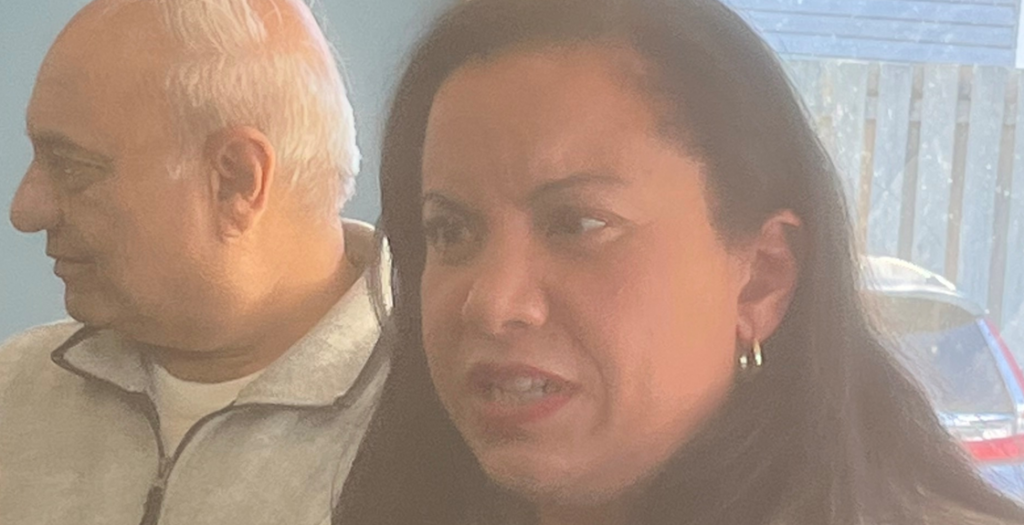
PARSIPPANY - As Analilia Mejia took questions from about 50 people at a Saturday "town hall," Justin Musella raised his hand. He is a former Republican Parsippany councilman.
Knowing that Mejia backs "Medicare for All" and expanding free college education, Musella asked where do you get the money to do that without raising taxes on everyone sitting in the room?
He referred to a study that suggested Medicare for All alone would cost about $25 trillion.
"Over 10 years," Mejia said.
OK. But still, we're talking about lots of money - even if it is "only" $2.5 trillion a year.
Mejia may not have been ready for Musella, but she seemed ready for the question. After all, her views on Medicare are staples of today's progressive philosophy.
"You have to also remember that premiums are a form of taxation," she said.
Mejia mentioned that health insurance premiums on average have gone up about $700 a month. Part of this is because of the ending of Obamacare subsidies.
"You already had a tax increase for your health care costs, but we don't call it a tax."
She spoke of "greater tax fairness." She said the "Big, Beautiful Bill," which Mejia and other Dems call the "Big, Ugly Bill," transferred wealth from average people to the very wealthy.
She estimated that the tax benefits for many middle class families have been in the hundreds of dollars, but they have been in the "tens of thousands" for the wealthy.
Reversing that dynamic is step one, Mejia said.
The next step would be closing corporate loopholes.
"You also have corporations who right now pay negative or zero in income tax," she said.
Along these lines, she also criticized changes in the federal estate tax, which now exempts $30 million in income for a married couple. This is a much higher threshold than previously.
At one point in what was a seven-minute answer, she said her monthly insurance premium was about $1.200.
She asked Musella what he pays?
He said his bill was "around" what Mejia says she pays.
Now we come to her main point. How about simply doing away with individual premiums?
How about if someone would pay, say, $400 more a month in payroll taxes, but no longer pay any premiums? Wouldn't they come out ahead?
The math is easy here. Paying another $400 in taxes is preferable to paying $1,200 a month in premiums.
Musella replied:
"It's like everything else, I mean, how long is that guarantee good for?"
Mejia referred to Social Security and Medicare, saying they are good as long as, "We fight for it."
Her point: Congress, as the third branch of government, has a lot of power. As long as it is committed to funding a program such as Medicare for All, it would be able to do it.
Obviously, this has to do with priorities. And it allowed Mejia to criticize the war in Iran as an example of an administration with messed up priorities.
More generally, she asked:
"What is the common good?
I would argue that the common good should include people (who) should have access to health care because without it, you die."
To that end, she spoke of using the "collected pot" of tax money to prioritize such things as health care.
Her response drew cheers, which was not surprising. Candidate town halls generally attract supporters of the candidate.
At the same time, Musella's question gave this event some spark. Good to see.