
Mikie Sherrill, the Democratic Party, and the Ongoing Challenge of Labor
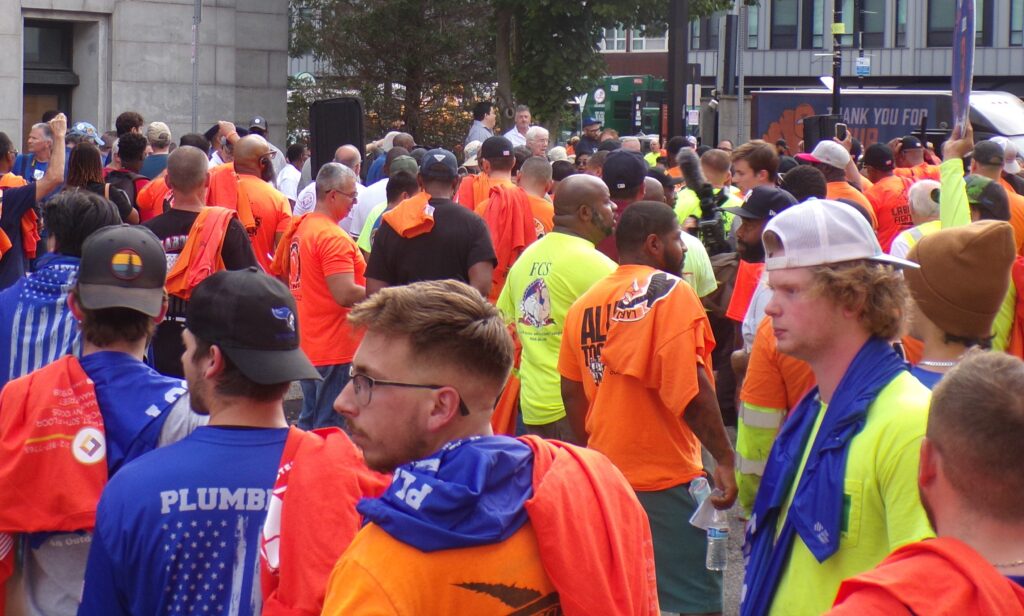
Already divided on the heels of 2024, Labor would find itself wrangling with difficult challenges in the 2025 political season, ultimately unresolved.
Tonight, Mikie Sherrill made a statement in the right direction, toward reclaiming a vital, foundational part of the Democratic Party base.
By way of background:
The most recent chapter of the troubles started last year, when Joe Biden dematerialized onstage and the Democratic Party had to swap him out in favor of Kamala Harris. Humiliated Building Trades guys who backed Biden felt more forcefully capable of moving over to the Trump column. They had already been gravitating that way, anyway, but they really stared moving.
Fast forward to this year and the Democratic Primary, in a state long separated by public and private sector Labor divisions.
Underscoring that divide, Sean Spiller (head of the New Jersey Education Association) ran with an expressed public sector worker priority. Steve Sweeney, an ironworker by trade, ran with the backing of the Building Trades, the touchstone of private sector Labor. Newark Mayor Ras Baraka ran with the backing of multiple progressive Labor organizations, among them 32BJSEIU and the Working Families Party. The Firefighters Mutual Benevolent Fund (FMBA) of NJ backed Mikie Sherrill.
Having split up significantly in the Primary, these different Labor organizations found it difficult to come together in the general. While Sweeney and Baraka endorsed Democratic nominee Sherrill, along with Steve Beatty, the new President of the NJEA, and the Laborers backed her, as well as SEIU, the Building Trades as a whole refused to issue an endorsement. The Operating Engineers went to Jack Ciattarelli. So did the Fraternal Order of Police. The Professional Firefighters Association didn’t endorse.
In the words of one Labor insider, all the organizations “didn’t come together wholeheartedly as I would have liked.” The AFL-CIO continued to have a strong president here in Charles Wowkanech, whose shop piled on a steady diet of data-driven Labor pieces making the case for Mikie Sherrill’s candidacy. Members in the organization did worry, however, about the closeness of the contest, and given Sherrill’s 100% pro-Labor voting record, they would have preferred a greater show of unified Labor support. Hardhat guys scheduled to speak at the Obama rally got chopped for time.
Sources in the movement spoke of the Democratic Party losing white male workers.
It was grim.
In early October, Eddie Donnelly, President of the FMBA and a strong and early Labor backer of Sherrill, addressed the troubles among rank-and-file guys.
"Social issues are your social issues," said the firefighter labor leader. "What we do - what you [FMBA members] elect me to do - is to go out there and vet the candidates and make sure they're right and squared away on the issues important to us. We went out there and we brought it back. The other candidate [Jack Ciattarelli] has been in elected office or trying to reach elected office for decades. His track record is horrible for labor, whether he was a freeholder and tried to merge police departments with no concern for collective bargaining, on the floor of the assembly where he spoke viciously against firefighters and police officers [seeking permanent implementation Chris Christie's 2% arbitration cap, which would override binding interest arbitration for firefighters, specifically put in place by the legislature as a labor protection because firefighters can't strike], and as a gubernatorial candidate he outright said pensions and benefits need to be reformed.
"This is a private sector, management kind of guy," Donnelly said. "His moral compass is not in line with labor in New Jersey."
It took President Donald Trump to drive that point home, when by mid-October he gleefully announced his “termination” of the Gateway Tunnel, a massive critical infrastructure project employing thousands of Building Trades workers. Already on record as not disagreeing with the President on any one issue and awarding him an “A” as a national leader, Ciattarelli appeared flat-footed in his reaction to the President’s announcement. Trump looked like he took vindictive delight in killing the vital $20 billion project advanced by his predecessor, President Biden.
Trump tomahawked Ciattarelli when he did that, giving skeptical workers a reason to back Sherrill. In the last couple of weeks of the campaign, Sherrill’s energy moved people in the middle away from the MAGA Wildwood crowd types populating a lot of Ciattarelli events.
But just as Phil Murphy in 2017 had the task in front of him of uniting public and private-sector Labor (which he did, almost miraculously, given the depth of rancor between Sweeney and Murphy early), Sherrill - stampeding to victory tonight - would have her own set of Labor challenges. Even after Biden’s very pro-Building Trades record, Murphy’s advancement in NJ of historic Labor gains, including raising the minimum wage, and codifying project labor agreement laws, and even after inflation and unemployment rose in the Trump years, and the president deviously yanked the plug on Gateway, many working class men remained reticent to affiliate with the Democratic Party.
Democrats had a problem on that front, and while it afflicted them nationally, as they appeared unable to unite the priorities of Labor as that clear and chief organizing party principle, it fell to Sherrill – powered in the general election by women, and men - to figure it out in New Jersey, a state with strong labor laws, the strongest in the country, in fact - but still lacking effective labor law government enforcement. Moreover, so long as the shutdown continued and Trump threatened the termination of tunnel funds, the governors of New York and New Jersey would likely find their financial improvisational skills truly tested, not just on behalf of commuters, but workers, both private and public sector, as at no other time.
Phil Murphy never had quite that challenge, but he did come into office with labor divided, and the leaders of the Building Trades out to get him, as he cohered public sector labor on his side as the starting point for a genuine fight. Over the course of eight years, Murphy – whatever his deficiencies in other areas – built a strong record as a pro-labor governor. His achievements across a broad area of pro-worker protections and advancements include a targeted 2026 $15.96 minimum wage, pay equity, project labor agreements (PLAs) for all capital construction projects exceeding $5 million, and a temporary worker bill of rights, to name a few. The next governor, according to Building Trades Chief Billy Mullen, will have the unique test, not to write new laws, but to effectively champion and enforce the strong New Jersey laws on the books, in part thanks to Murphy.
But make no mistake.
Democrats know by now the source of the growling underbelly in their midst, and it’s Building Trades Labor. In addition to enforcing those PLA-protecting laws on the books (she has promised, after all, to make government more effective), Sherrill - with a bold mandate - needs to barrel into the union halls and smash beer glasses against the walls. She needs to throw on the hard hat and talk to Labor, in Labor’s language. She can do little things to show her party doesn’t hate men, one Bergen source told InsiderNJ, like reducing hunting and fishing license fees - and she absolutely has to own the big things, like ensuring the advancement of Gateway.