
AS EXTREME HEAT AND FLOODING TEST NEW JERSEY'S RESILIENCE, NEW RESEARCH SHOWS THAT 35 MUNICIPALITIES WILL HAVE 100 PERCENT OF PUBLIC ASSETS IN FLOOD ZONES BY 2050
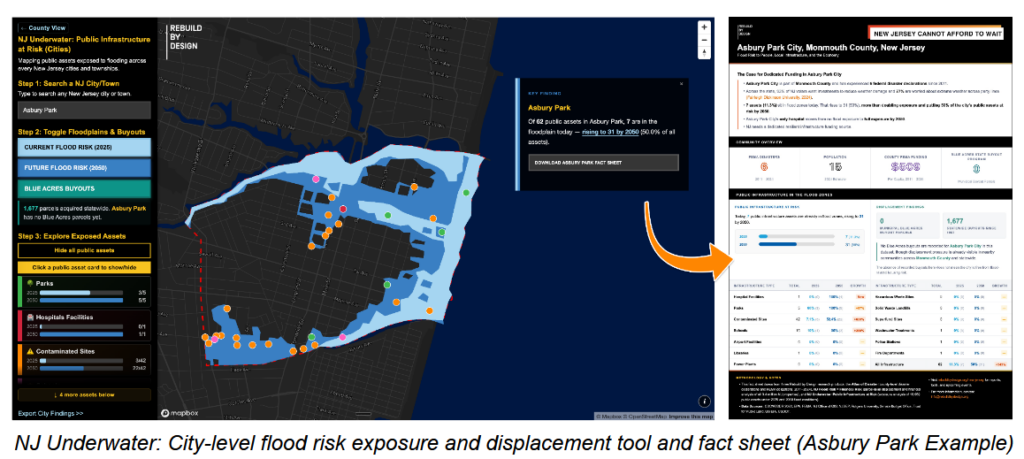
Rebuild by Design’s new analysis of New Jersey’s 564 municipalities shows growing risk to public assets in communities across the state and calls for a state resilient infrastructure fund to mitigate future risk of extreme weather.
July 8, 2026 - As New Jersey communities face a heat wave and widespread flooding, new research finds 35 municipalities are projected to have 100% of their public assets located in flood risk areas by 2050, while 155 municipalities will have at least half of their public assets at risk. The new report, by Rebuild by Design identifies current and future flood risk to municipal public infrastructure assets – such as schools, libraries, parks, airports, and wastewater treatment plants – and demonstrates the cascading economic impacts to local government and taxpayers who will be on the hook to pay for repairs and rebuilding.
In the past week, 29 residents lost their lives to the extreme heat wave. At the same time, recent heavy rainfall has added to a growing list of devastating flood events that have inundated roads, neighborhoods, and critical infrastructure, including a July 2025 event that claimed the lives of two people in Plainfield after their car was swept away. These tragedies emphasize the need to invest in infrastructure that protects both people and the public assets they rely on.
“When extreme weather hits, the bill comes in the form of higher tax dollars, insurance hikes, healthcare, repairs, business losses, and relocation. In the worst cases – it comes in the form of loss of life,” said Amy Chester, Director of Rebuild by Design, “New Jerseyans will be the ones paying these costs if the State does not take proactive measures to invest in risk mitigation and long-term adaptation.”
NJ Underwater's Key Findings:
-
Today, of the 564 municipalities in New Jersey, 486 (86%) New Jersey have public assets located in flood risk areas, rising to 525 (93%) by 2050.
-
Thirty-five New Jersey municipalities will have 100% of their public assets in flood zones by 2050.
-
At least 155 municipalities will have at least half their assets at risk by 2050.
-
Across New Jersey's five largest cities (Newark, Jersey City, Paterson, Lakewood, and Elizabeth, with a combined population of over 1 million), the share of public assets in flood zones nearly doubles by 2050, from 23% (509 assets) today to 42% (945).
-
Flooding threatens $435.9 billion in property value and $5.9 billion in annual property tax revenue statewide.
-
Nearly 1 in 4 public assets across the state sits in current flood zones; by 2050, more than 1 in 3 will, a 55% increase.
The analysis being released today is an expansion of Rebuild’s NJ Underwater interactive risk-mapping tool, which now includes data and downloadable fact sheets for all municipalities in New Jersey. Residents can now search their municipality’s flood risk through an interactive map and download a customized fact sheet for every municipality.
The urgency of these investments is clear. New Jersey has experienced 14 federally declared disasters between 2011 and 2024. This includes the remnants of Hurricane Ida, which killed more than two dozen people across the state after record-breaking flash flooding trapped residents in homes, apartments, and vehicles.
"This analysis makes clear that the cost of inaction is rising with every storm. Climate change is a global challenge, but adaptation happens through local decisions about where and how we build," said Diane Schrauth, Policy Director at New Jersey Future, "As New Jersey adapts to the realities of a changing climate, we must invest in resilient infrastructure and land use policies that reduce future flood risk and protect lives, homes, businesses, and public assets.”
The report calls for the state to proactively invest in hazard mitigation and climate adaptation projects by establishing a state resilient infrastructure fund. Such a fund could support water quality, air quality, and resilience projects, while creating good quality jobs for New Jersey. This approach is already underway in New York, where $2.25 billion has been allocated through the Clean Air, Clean Water, and Green Jobs Environmental Bond Act since 2022.
A $5 billion fund could support tens of thousands of jobs which would multiply further with federal matching funds, according to research by AECOM and Rebuild by Design. This type of investment has strong bipartisan support. Ninety-three percent of New Jersey voters say it is important for the state to invest in projects that reduce weather damage, including 97% of Democrats and 89% of Republicans.
To explore Rebuild by Design's NJ Underwater risk tool, and search for flood risk for 564 municipalities, see below.
|
Interactive Map |
Fact Sheets |
|
|
Municipalities (Cities) |
||
|
Counties |
Rebuild by Design is housed at the Institute for Public Knowledge at NYU and works with communities and local governments to co-design policies, projects, and programs to adapt to the worsening impacts of extreme weather. Rebuild ‘s hallmark series, the Atlas of Disaster, features advanced research and analysis of disaster impacts across the United States, including additional data for New Jersey.