
Yes, in New Jersey, Your Local Government Can Stop an ICE Detention Facility
By Guy Citron
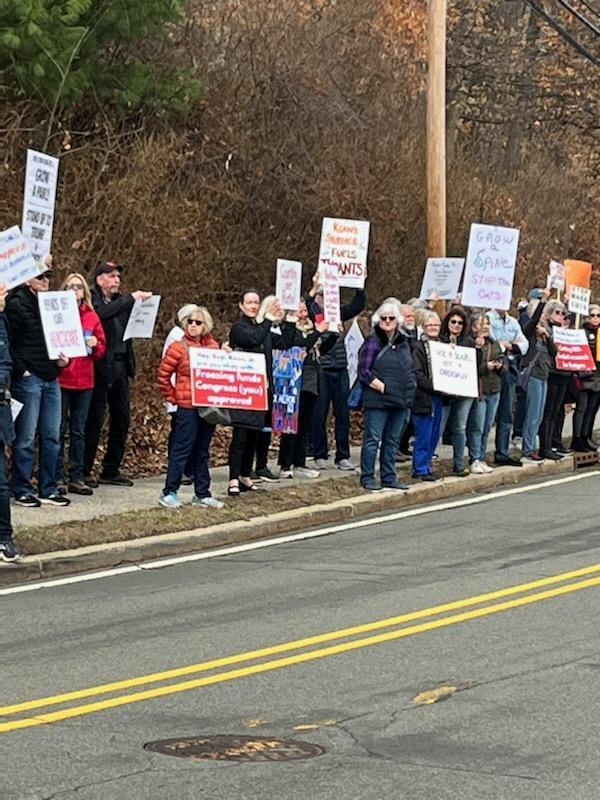
About 75 residents packed the Roxbury Township Council meeting on December 30 after a Washington Post article raised a terrifying possibility: a vacant local warehouse could be repurposed into an ICE “processing” facility. The mayor stated, for the record, that neither he nor the council had received any official notice from the federal government.
Then the room spoke. For more than an hour, residents, faith leaders, and immigrant-rights advocates expressed fear, grief, and moral clarity.
One speaker detailed the human-rights abuses already occurring at Delaney Hall in Newark, New Jersey’s largest privately run ICE detention center, still operating without local permits. There, families wait for hours to see loved ones denied medical care, legal access, basic hygiene, clean food, and clean water. Many were taken without a warrant, or worse, effectively trapped while lawfully attending appointments to renew work permits or complete required paperwork.
Others named the deeper issue. ICE leadership has said immigration enforcement should operate “like a business.” But unlike a mom-and-pop business, this model relies on multinational corporations, funded by our tax dollars in the form of federal contracts, while dodging all ethical and moral concerns. That is why masked agents, warrantless arrests, and the absence of meaningful oversight are not accidents. They are features of this emerging corporate police state. When such profit incentives replace public accountability, what is sold as “law and order” becomes something closer to human trafficking, and state sponsored terrorism, to keep everyone in line.
The most powerful moment came when a local resident said simply, “This is not who we are.” She spoke of her grandfather who stormed the beaches of Normandy as a teenager, and of her own teenage son who is now afraid to leave the house because of the color of his skin. If this is about money, she asked, what is the price of your conscience—and is it worth destroying your town and your country?
Two weeks later, on January 13, the all-Republican Roxbury Township Council started answering that question by unanimously adopting a resolution that opposes any ICE detention or processing facility. For reasons why, they cited public safety, strain on local services, and incompatibility with community character. That vote matters. But here is the truth too few people are told: a resolution expresses values; a land-use ordinance exercises power. In other words, a town can stop a for-profit detention facility through zoning. Let me explain.
In New Jersey, municipalities hold real authority under the Municipal Land Use Law (N.J.S.A. 40:55D-1 et seq.). By statute, which is a fancy word for law, a town decides how its land can be used and under what conditions (N.J.S.A. 40:55D-62). Thus, zoning ordinances may define “detention,” “correctional,” or other involuntary-confinement facilities as impermissible land uses. That’s how municipalities may lawfully prohibit privately owned or privately operated detention centers outright.
Now some officials have argued, off the record, that none of this matters because of the Constitution’s “Supremacy Clause”, meaning, if the federal government wants a detention facility, local law must give way. But that is wrong in this context. The Supremacy Clause prevents states and towns from blocking federal operations themselves, such as a federally owned and operated facility. It does not exempt private corporations from local land-use rules, nor does it allow Washington to commandeer municipal zoning authority. Congress has not preempted local land-use law for privately run detention facilities. In plain English: the federal government may not order your town to rewrite its zoning code for a for-profit contractor.
That distinction matters. Why? Because most ICE detention facilities are run by private corporations that do not have federal sovereign immunity. Courts consistently treat private detention operations as ordinary land use applications subject to local zoning—not as untouchable federal functions. See Goodyear Atomic Corp. v. Miller, 486 U.S. 174 (1988); Hancock v. Train, 426 U.S. 167 (1976).
But let’s go a step further. Even when a town does not ban such facilities outright, it may impose performance standards these operations cannot realistically meet, such as: distance from homes, schools, and houses of worship; limits on fencing, floodlighting, or armed security; caps on traffic, noise, and demands on emergency services. And like any other commercial business, they also require permits, site plans, certificates of occupancy, and compliance with fire, health, and stormwater codes. Failure on even one condition is grounds for denial of land use, whether the applicant is a prison company or a pizzeria. Facilities operating without such local approval are not “federal exceptions.” They are simply businesses operating unlawfully.
So, let’s also be direct about where the moral line is being drawn. Bringing violent criminals to justice is something we all want. But illegal immigration, in reality, often means overstaying a visa, missing a deadline for paperwork, or being caught in a system so complex even attorneys struggle to explain it. These are civil violations, not moral ones. They call for reforms, not retribution. And they certainly do not justify racial profiling, police-state tactics, or mass detention for private profit.
Which brings us back to Roxbury. It is good that their all-Republican Council has said a detention facility is not who we are. That is real progress in many respects. And now that determination must be written into local land-use law.
So here is the master message. Every community in New Jersey has this same authority. If you do not want an ICE detention facility in your town or county, you do not have to accept one. Furthermore, when your town adopts clear zoning rules and enforceable standards for what uses are permissible, it is not making a partisan statement. It is exercising lawful self-government. That is what democracy looks like.
So here is the call to action. If you are worried about buildings in your town being turned into mass detention centers for private profit: show up to your local government meeting. Tell your council, or planning board, or land use board, to use the tools they already have. That means an ordinance, not just a resolution. What remains to be seen is whether you, and your neighbors, will insist that it does.