Reliving the Remembrance of the Marquis de Lafayette
MORRISTOWN - There were cannon blasts and the ringing of church bells at 1 p.m. on an otherwise peaceful Sunday in this Morris County town.
Just like 200 years ago.
Really.
On July 13-14, 1825, the Marquis de Lafayette returned to Morristown and other spots in New Jersey, visiting the nation he helped create.
It was a sort of Farewell Tour for a man who had outlived all his fellow contemporaries of the American Revolution.
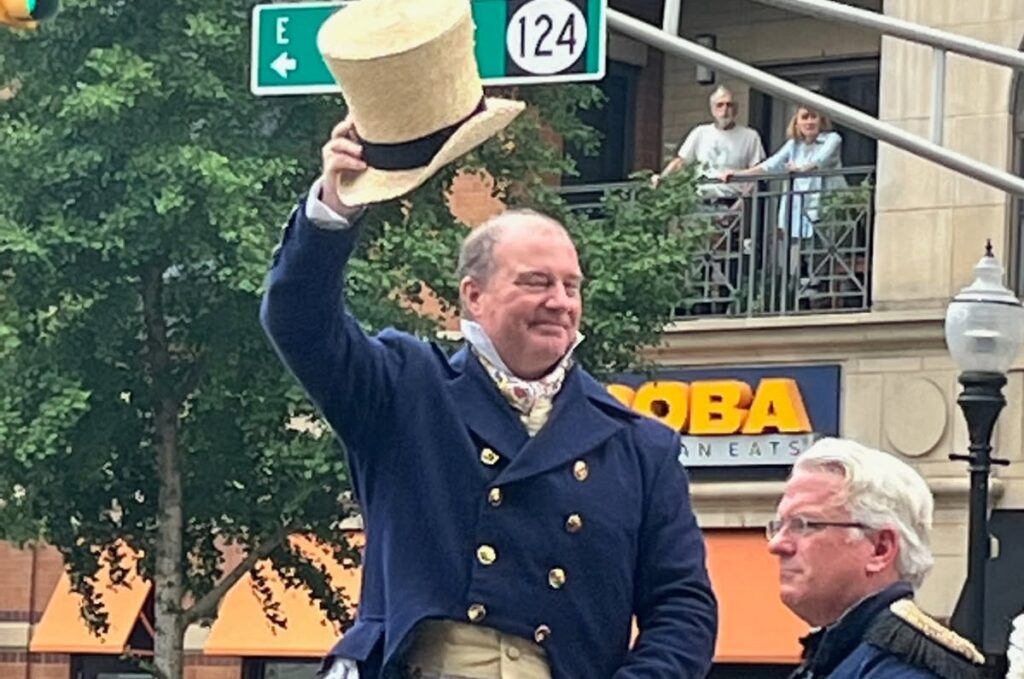
Now, two centuries later, Lafayette was back - pulling up to the Green in a horse-drawn carriage. Or at least a Lafayette re-enactor was back.
All this was part of a series of events commemorating General Lafayette’s 1825 visit organized by the American Friends of Lafayette.
The festivities drew a very nice crowd, people standing around the Green as Lafayette and his entourage circled the historic square. The "general" then disembarked and made his way to the speaker's platform.
Mayor Tim Dougherty, attired in period garb, played the role of John Stevens Darcy, a local businessman two centuries ago who welcomed Lafayette to town.
Dougherty did the same some 200 years later.
He and other speakers spoke of Lafayette not only as a military companion of Washington, but as a man ahead of his time.
Dougherty said Lafayette abhorred slavery - still prevalent in 1825 America - and that he believed in treating women as equal to men.
It was a nice touch.
There was also talk of the continuing friendship between France and the United States - a partnership that actually began before the U.S. was even an independent country.
Periodic shouts of Vive La France erupted from the crowd.
A band played a rousing edition of La Marseillaise, the French national anthem. That was followed by the singing of America the Beautiful.
When Lafayette spoke, he did so in a heavy French accent. His short address was quite simple as he thanked his hosts for their gratitude and that was basically it. This, presumably, followed what the real Lafayette said in 1825.
Then, there was time for some imbibing.
Various people on the podium, including the mayor, a man representing Black soldiers who fought for the Americans during the Revolution and state Assemblywoman Aura Dunn (LD-25) took part in offering "13 toasts" - a common practice at the time.
This was a nice historical touch, but also a symbolic one, as there was no real booze to be had.