Zwicker's AI Worker Protection Bill Passes out of Committee
TRENTON - The designations of "Democrat" and "Republican" seem quaint, to say the least, compared to what humanity finds itself up against in the form of artificial intelligence.
Numerous people testifying in favor of Senator Andrew Zwicker's (D-16) S-4075 today affirmed the necessity of "guardrails" to curtail big tech's AI onslaught. Used repeatedly, the term - another quaint noun predicated on actual spatial existence - seemed inadequate to the challenge, like something useful to prop up in the absence of a major counter offensive.
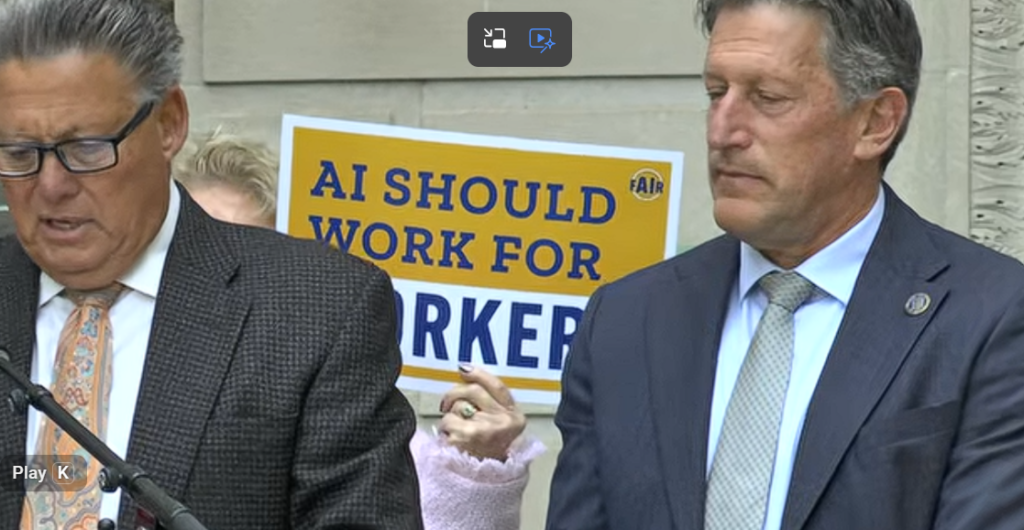
The Senate Labor Committee unanimously passed S-4075, good news for the labor movement, whose ranks packed the hearing room.
While President Donald Trump makes the case that artificial intelligence can regulate itself, New Jersey - with Zwicker in the lead - at least looks prepared to establish worker protections.
This bill is designed to ensure that there are reasonable guard rails on the use of systems using artificial intelligence (AI) and related technologies in places of employment and for public services. The bill regulates AI used in electronic monitoring tools (EMT) to collect and process a wide range of data and information about workers and job applicants and AI used by automated employment decision-making systems (AEDS) in making employment-related decisions such as hiring and firing. The bill also regulates automated benefit and service decision-making systems (ABSDS) used in making decisions related to providing public benefits and services.
But what does it mean finally if the political process has already empowered big tech and unchained AI to the point where no amount of human effort to truly regulate - to impose "guardrails" - will matter?
"Say super intelligence not AI," a wiseacre cracked as the hearing got underway, as if New Jersey - where the two Republicans on the labor panel (Senators Doug Steinhardt and Vince Polistina) voted (gingerly) in favor of the bill, would pay attention and implement Trump's terminology.
Still, the currents of AI running through everything, contained deeper and more hazardous implications.
At the core of Zwicker's bill is language to prohibit AI from firing workers, with corresponding criminal penalties for violations. But can state government regulating arms keep pace?
"We have not seen anything as fast as this," said Zwicker.
These questions permeated the atmosphere as the committee - with Labor Commissioner Kevin Jarvis in the room taking an obvious interest in developments.