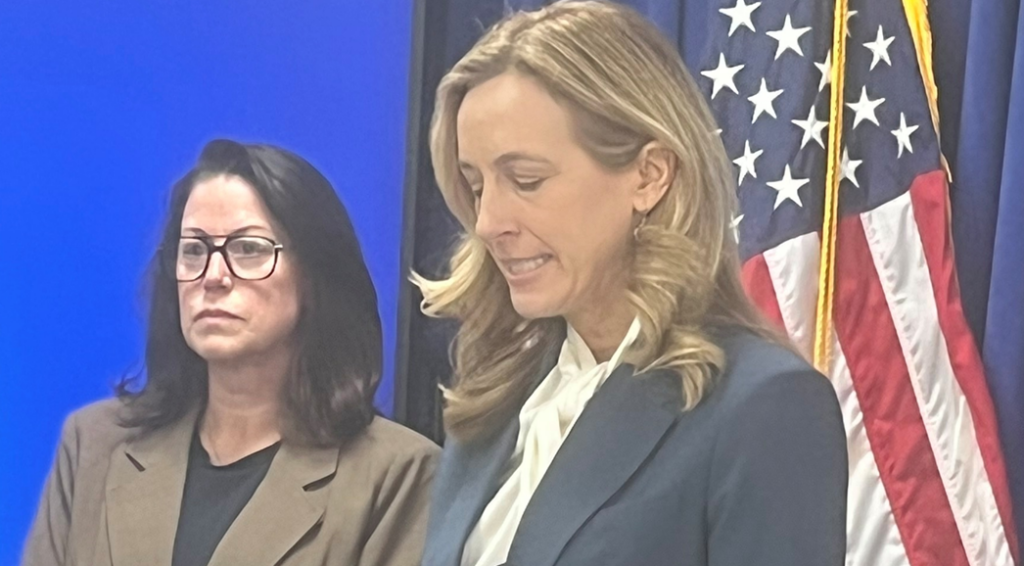
TRENTON — Attorney General Jennifer Davenport today co-led a coalition of 24 attorneys general and two governors in suing the Trump Administration to stop its unlawful implementation of new Medicaid work requirements included in President Trump’s One Big Beautiful Bill Act (OBBBA).
Beyond the harms created by the changes to Medicaid in the OBBBA itself, the Trump Administration’s proposed rule narrows the Act’s exemptions from Medicaid work requirements for “medically frail” people. These exemptions ensure that those with serious or complex conditions, mental disorders, substance abuse disorders, and other medically vulnerable individuals do not lose coverage or face interruptions in care. But the rule will cause many of those patients to lose care, by implementing onerous requirements to prove a patient’s condition also significantly impairs their ability to work.
“Everyone deserves affordable healthcare. The Trump Administration’s new rule kicks patients with stage 4 cancer and early onset Alzheimer’s off Medicaid, unless these patients jump through bureaucratic hoops to prove they are too sick to work,” said Attorney General Davenport. “The new Medicaid work requirements are likely to cause over 300,000 New Jerseyans to lose access to lifesaving care due to onerous bureaucratic requirements, not actual ineligibility. We are suing to stop this cruel and unlawful rule. I will continue to fight against unlawful efforts that would increase costs to people with serious illnesses and disabilities.”
Attorney General Davenport, California Attorney General Rob Bonta, and Massachusetts Attorney General Andrea Joy Campbell will hold a virtual press conference today at 5:00 p.m. EDT to discuss the illegal provisions of this rule.
Despite months of working with states on implementation, the Centers for Medicare & Medicaid Services (CMS) surprised states on June 1 with an interim final rule, “Community Engagement Requirement for Certain Individuals,” which makes it harder for medically vulnerable individuals to be excused from the work requirements by requiring proof that their condition significantly impairs their ability to work. States had already made substantial investments in reliance on the plain language of the OBBBA and CMS’s prior guidance, and now face the risk of harsh financial penalties for noncompliance with the interim final rule.
The interim final rule makes other changes that increase administrative burdens, create unnecessary red tape, and put eligible people at risk of losing their health coverage — including those who are already working or qualify for an exemption. The rule disregards substantial evidence that should have been considered, fails to adequately evaluate reasonable alternatives, and does not give states clear or workable guidance. Past Medicaid work requirement experiments in other states have shown that added red tape causes eligible people to lose coverage, placing greater strain on state Medicaid programs, safety net providers, and emergency rooms, while increasing costs market-wide as more medically frail residents become uninsured.
The rule itself estimates that over 3 million people will lose Medicaid as a result of the new work requirements, many of whom remain eligible but are unable to complete the necessary paperwork in the required timeline.
While the work requirement provision applies beginning January 1, 2027, the law requires states to notify Medicaid recipients about these changes by August 31, 2026. The states need significant lead time to accurately advise beneficiaries about these changes, but cannot do so given the unlawful provisions of the implementing rule and lack of guidance from CMS. States cannot wait for CMS to address the deficiencies through the ongoing rulemaking process. As a result, the attorneys general are seeking to block implementation of the interim final rule’s illegal provisions while the lawsuit is pending.
In today’s lawsuit, the coalition alleges that the interim final rule:
· Unlawfully narrows Congress's protections for medically frail Medicaid recipients.
· Violates the Administrative Procedure Act by ignoring substantial evidence that work reporting requirements cause eligible individuals to lose healthcare coverage because of administrative barriers rather than a failure to work.
· Fails to adequately consider the significant harms that will be imposed on states, Medicaid beneficiaries, healthcare providers, and state healthcare systems.
· Unconstitutionally imposes vague and ambiguous requirements on states after they had already begun implementing the OBBB based on the statute’s plain language and CMS’s prior guidance.
Medicaid is the nation’s safety net healthcare program for low-income Americans and is jointly funded by states and the federal government, with the federal government providing at least 50% of the cost of services.
In New Jersey, Deputy Solicitor General Shankar Duraiswamy, Senior Counsel Samuel Dolinger, Deputy Attorney General Jake Mazeitis, and Deputy Attorney General Geoffrey McGee handled the matter.
The lawsuit was co-led by Attorneys General Davenport, Bonta, and Campbell. They were joined by the attorneys general of Arizona, Colorado, Connecticut, Delaware, District of Columbia, Hawai‘i, Illinois, Maine, Maryland, Michigan, Minnesota, Nevada, New Mexico, New York, North Carolina, Oregon, Rhode Island, Vermont, Virginia, Washington, and Wisconsin, and the governors of Kentucky and Pennsylvania.