
Independent Review Concludes NJ Comptroller Exceeded Legal Authority and Issued Flawed Irvington Opioid Report

Independent Review Concludes NJ Comptroller Exceeded Legal Authority and Issued Flawed Irvington Opioid Report!
Irvington, NJ — A newly released independent legal and professional review has determined that the New Jersey Office of the State Comptroller (“OSC”) acted beyond the limits of its statutory authority, deviated from nationally recognized investigative standards, and produced a report riddled with procedural defects and internal inconsistencies concerning the Township of Irvington’s use of opioid settlement funds.
The review was prepared by Scott J. MacDougall, a former senior official within the Office of the State Comptroller who served for years as Director of Investigations, and who is now a partner at DeCotiis, FitzPatrick, Cole & Giblin, LLP. Relying on both rigorous legal analysis and firsthand institutional experience, the review examined OSC’s July 8, 2025 Strategic Initiatives Unit report and concluded that it is not a reliable basis for enforcement actions, reimbursement demands, or punitive measures.
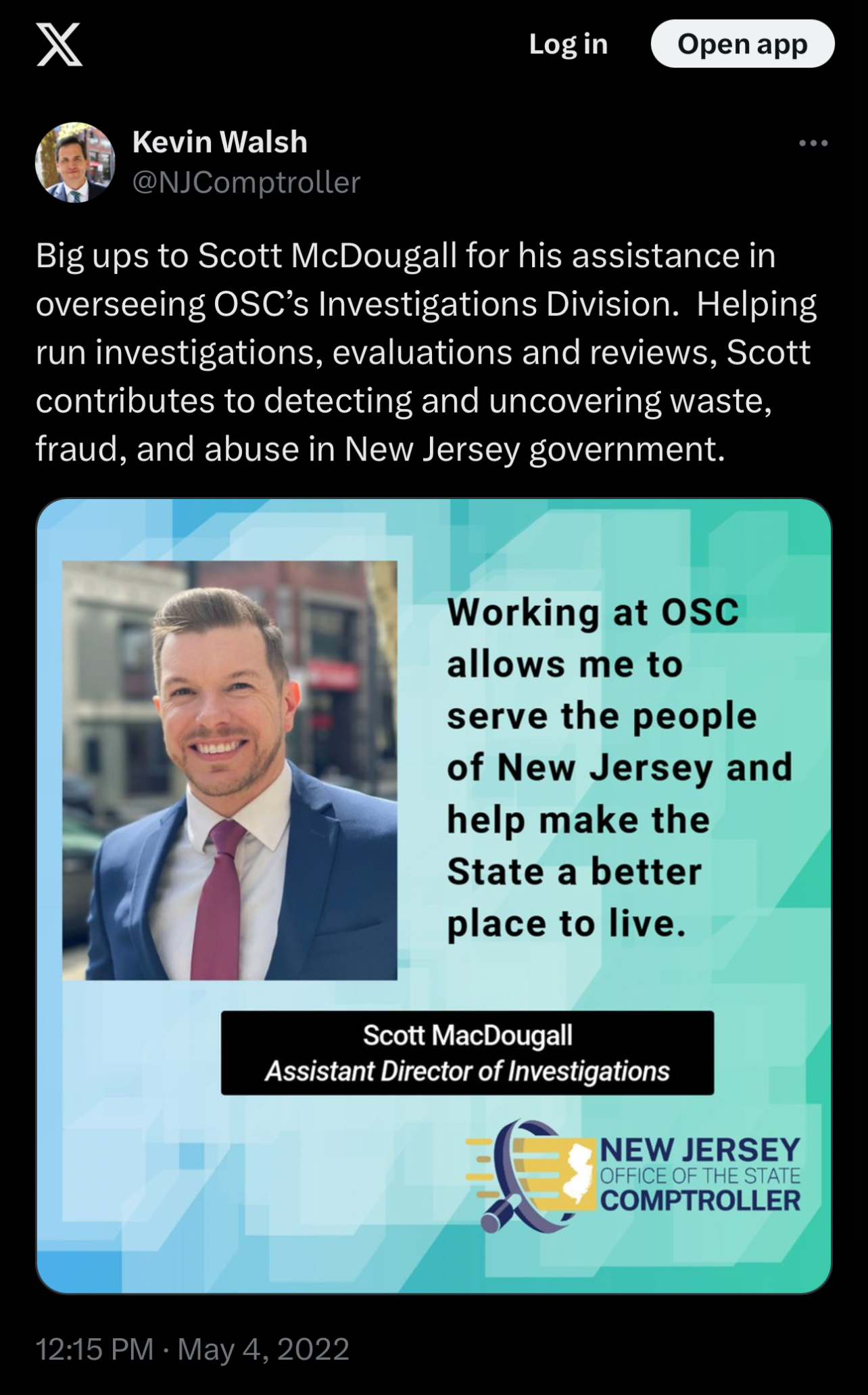
Mr. MacDougall’s qualifications are rooted in his extensive tenure inside the Comptroller’s Office, where he oversaw complex investigations and applied professional oversight standards. His expertise was publicly acknowledged by OSC leadership during his service. On May 4, 2022, at approximately 12:15 p.m., then–Acting State Comptroller Kevin Walsh, posting from the official New Jersey Office of the State Comptroller platform, publicly praised Mr. MacDougall’s work, stating:
“Big ups to Scott MacDougall for his assistance in overseeing OSC’s Investigations Division. Helping run investigations, evaluations, and reviews, Scott contributes to detecting and uncovering waste, fraud, and abuse in New Jersey government.”
That contemporaneous recognition—issued while Mr. MacDougall was actively serving within OSC—underscores that the conclusions reached in this independent review are informed by professional judgment and investigative standards previously relied upon and commended by the Comptroller’s own office.
Core Conclusions of the Review
The review finds that OSC’s Irvington report is undermined by multiple, compounding flaws, including unresolved internal contradictions, reliance on standards that had not been defined in law, disregard of express statutory exceptions, inconsistent evidentiary thresholds, procedural unfairness, and violations of fundamental due-process principles. Taken individually and collectively, the review concludes, these defects eliminate any entitlement to judicial or institutional deference.
Internal Contradiction: Total Condemnation Versus Partial Remedy
At the center of the review’s findings is a fundamental inconsistency. OSC repeatedly characterized approximately $632,000 in opioid-related expenditures as entirely “wasted” and “misspent.” Yet, in the same report, OSC recommended reimbursement only for certain portions of those expenditures—specifically those it deemed unsupported by evidence-based strategies.
The review describes this as a contradiction that cannot be reconciled. An agency, it explains, cannot plausibly assert total misuse of public funds while simultaneously acknowledging partial compliance.
Why it matters: Courts consistently regard internal inconsistency as a hallmark of arbitrary and capricious agency action. Absolute conclusions demand absolute proof; a narrowed remedy concedes that such proof is lacking.
Enforcement of Standards That Did Not Exist
The review further concludes that OSC evaluated Irvington’s conduct against “evidence-based” and “evidence-informed” criteria that were not defined at the time the expenditures were made. Under New Jersey’s statutory framework, responsibility for defining and administering opioid settlement standards lies with the Department of Human Services (DHS)—not the Comptroller’s Office.
When OSC conducted its investigation:
- DHS had not issued binding definitions;
- The Advisory Council’s statewide framework remained unfinished; and
- No law or directive empowered OSC to establish substantive public-health standards.
Despite this, OSC supplied and enforced its own definitions, which the review characterizes as unauthorized rulemaking.
Why it matters: Agencies may apply existing law; they may not retroactively create it. Enforcing undefined standards violates due process and constitutes ultra vires conduct, which is legally void from inception.
Failure to Apply the Extraordinary Use Spending Exception
The review also identifies OSC’s omission of the Extraordinary Use Spending (EUS) exception as a standalone legal error. That exception expressly allows community-specific, nontraditional opioid-abatement initiatives, particularly where stigma, access challenges, and harm reduction are central concerns.
According to the review, Irvington’s outreach efforts fell squarely within this statutory provision. Nonetheless, OSC failed to analyze or even acknowledge the EUS exception in its report.
Why it matters: Ignoring an applicable statutory exception is per se arbitrary and capricious and independently invalidates an agency’s conclusions.
Evidence Discounted Through Escalating Criteria
The review further documents a pattern in which OSC repeatedly claimed there was “no evidence” of compliance while simultaneously acknowledging the presence of health-department participation, Rutgers MAT clinician involvement, Narcan availability, outreach engagement, sign-in sheets, and sworn certifications.
Rather than weighing that evidence, OSC repeatedly raised the bar for what it would accept as proof—an approach commonly described as “moving the goalposts.”
Why it matters: National investigative standards prohibit shifting evidentiary requirements during an investigation. Courts view such practices as confirmation bias and procedural unfairness.
Investigative Label, Adjudicative Impact
Although OSC described its work as “investigative,” the review concludes the report functioned in practice as an adjudication. It declared violations, demanded reimbursement, and caused reputational harm—without providing hearings or procedural protections.
Why it matters: Courts focus on the effect of agency action, not the label applied to it. Actions with adjudicative consequences trigger constitutional due-process safeguards.
Broader Implications
The review characterizes the Irvington report not as an isolated lapse, but as evidence of systemic investigative failure. It concludes that the report is not entitled to deference and cannot lawfully support enforcement, reimbursement, or reputational penalties.
The review further cautions that, if substantiated, the defects identified raise broader concerns about OSC’s adherence to statutory limits, professional norms, and constitutional constraints.
Response from Irvington Officials
Mayor Tony Vauss said the review validated long-standing concerns about the OSC report’s methodology and conclusions.
“The most disturbing aspect is not disagreement—it’s condemnation without regard for the law,” Mayor Vauss said. “We acted within the statutory framework, sought guidance, and worked in good faith to address a serious public-health issue. Being accused of ‘waste’ while OSC simultaneously concedes partial compliance and ignores express statutory exceptions is not oversight. It is fundamentally unfair. Irvington deserved a lawful review, not hindsight punishment.”
Township Attorney Ramon Rivera echoed those concerns, emphasizing the legal ramifications.
“From a legal standpoint, the issue is not criticism, but process,” Rivera said. “This report applied standards that did not exist, disregarded statutory exceptions that do, and imposed consequences without due process. That approach is incompatible with lawful oversight in New Jersey. When an agency substitutes its own judgment for the Legislature’s framework and publishes condemnatory conclusions, it erodes public confidence and exposes the process as legally unsound.”
Enumerated Violations Identified in the OSC Irvington Opioid Report
The assessment identifies the following non-exhaustive but comprehensive list of violations, each of which independently undermines the legality, fairness, and reliability of OSC’s report. Taken together, they demonstrate systemic investigative failure, not isolated error.
Statutory and Jurisdictional Violations
- Violation of Statutory Limits on Investigative Authority
OSC exceeded the authority granted to it by statute by acting outside the jurisdictional and functional boundaries imposed by the Legislature. - Usurpation of Authority Vested in the Department of Human Services (DHS)
OSC unlawfully assumed DHS’s statutory role by defining and enforcing “evidence-based” and “evidence-informed” standards reserved by law to DHS. - Unauthorized Rulemaking Through Self-Selected Definitions
OSC created and applied its own definitions of key statutory terms without legislative authorization and before DHS issued governing standards. - Failure to Observe Statutory Sequencing and Coordination Requirements
OSC issued definitive compliance determinations before DHS and the Opioid Recovery and Remediation Advisory Council finalized the statewide Strategic Plan. - Premature Issuance of Findings Before Completion of the Statutory Framework
OSC acted before the governing public-health framework was completed, preempting the policy-setting function assigned to DHS. - Failure to Apply the Extraordinary Use Spending (EUS) Exception
OSC ignored or failed to analyze the statutory EUS exception expressly permitting nontraditional, community-responsive opioid-abatement strategies. - Erosion of Statutory Uniformity Across Municipalities
By independently defining compliance standards on a case-by-case basis, OSC undermined the Legislature’s intent to establish a uniform statewide framework.
Violations of Mandatory National Investigative Standards
- Failure to Conduct the Investigation in Accordance with Prevailing National Standards
OSC violated statutory mandates requiring compliance with nationally accepted investigative standards, including the Association of Inspectors General’s Principles and Standards (“Green Book”). - Conclusion-Driven Investigation Rather Than Neutral Fact-Finding
The investigation reflected outcome-oriented analysis rather than objective, neutral fact-gathering. - Selective Discounting and Suppression of Exculpatory Evidence
OSC selectively discounted, minimized, or omitted evidence favorable to the Township, including public-health participation, Narcan availability, outreach activity, and clinical engagement. - Use of Shifting and Undefined Evidentiary Standards (“Moving the Goalposts”)
OSC repeatedly changed evidentiary requirements after evidence was produced, imposing escalating and previously unstated demands. - Improper Reliance on Absence of Documentation as Proof of Noncompliance
OSC treated documentation gaps as affirmative proof of misuse, improperly inverting the burden of proof. - Improper Discounting of Clinical Participation by Rutgers MAT Clinicians
OSC acknowledged clinical involvement but disqualified it based on a fabricated requirement that Rutgers formally “endorse” the funding—required by no law or standard. - Subjective Recasting of Qualitative Disagreement as Legal Violation
OSC substituted subjective judgment for objective legal or professional standards without citing governing benchmarks. - Overly Granular and Aesthetic Critiques Untethered from Law or Standards
OSC criticized messaging design and billboard content based on unstated aesthetic preferences rather than statutory or regulatory requirements. - Failure to Maintain Professional Reporting Discipline and Objectivity
OSC failed to distinguish between factual findings, evaluative judgment, and policy determinations.
Internal Inconsistencies and Arbitrary Conclusions
- Internal Contradictions Between Findings and Recommendations
OSC declared expenditures entirely “wasted” while recommending reimbursement for only certain portions. - Use of Inflammatory and Absolutist Language Unsupported by the Record
OSC used categorical terms such as “waste,” “misuse,” and “no evidence” despite acknowledging contrary facts. - Failure to Distinguish Between Partial Compliance and Noncompliance
OSC issued sweeping condemnatory findings despite a record reflecting mixed or partial compliance. - Inconsistent Treatment of Partial Implementation Across Audit Reports
OSC altered evaluative language in later audits to collapse partial compliance into noncompliance without justification.
Due-Process and Procedural-Fairness Violations
- Transformation of Investigative Activity into De Facto Adjudication
OSC declared violations, demanded reimbursement, and recommended sanctions without due-process protections. - Failure to Provide a Meaningful Opportunity to Respond to New Evidence
OSC incorporated post-draft testimony without allowing Irvington to review or respond. - Selective Quotation and Mischaracterization of Testimony
OSC selectively quoted officials while omitting sworn clarifications that materially altered meaning. - Omission of the Township’s Request for Technical Assistance from the Report
OSC excluded relevant mitigating context demonstrating good-faith cooperation. - Premature and Inaccurate Representations to the Court
OSC falsely represented that Irvington failed to participate before the response deadline expired. - Premature Release of the Report While Judicial Relief Was Pending
OSC disseminated the report to State leadership despite an active court application to stay publication. - Cumulative Due-Process Violations and Procedural Unfairness
Taken together, OSC’s conduct deprived Irvington of a fair, balanced, and lawful investigative process.
Failure of Statutorily Required Oversight Functions
- Failure to Provide Statutorily Required Technical Assistance After an Express Request
OSC disregarded its mandatory duty to provide technical assistance despite a written request made in good faith. - Punitive Escalation Without Exhausting Preventative or Remedial Oversight Tools
OSC bypassed corrective and advisory functions and escalated directly to public condemnation. - Escalation of Oversight Measures Without Statutory Justification
OSC sought extreme remedies, including a fiscal monitor, despite ongoing cooperation and corrective efforts.