
Newark Airport Service Workers Rally to Demand Safety, Alleging Extreme Heat, Safety Violations, and $2M Wage Theft
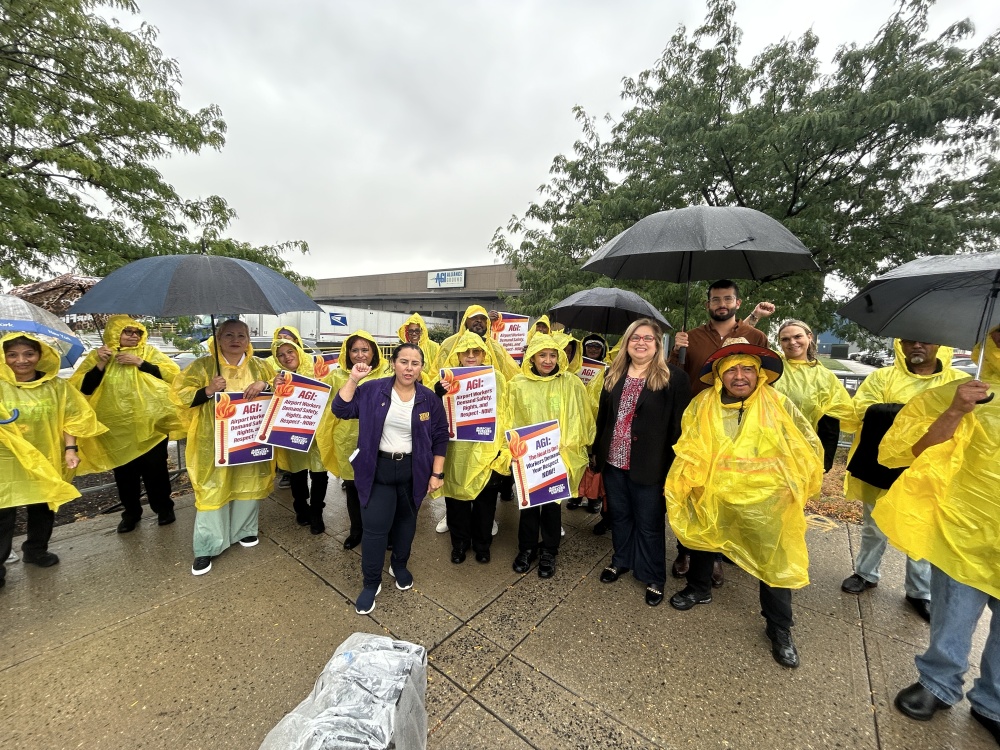
- Ground handling, cargo, ramp workers at EWR are requesting the OSHA 300 Log from their employer AGI, and demanding safety protections
- 2024 OSHA data show AGI injury rate at EWR higher than industry average
- 32BJ SEIU research finds alleged violations of the National Labor Relations Act, and AGI failed to comply with state Healthy Terminals Act
- August 20 airport action part of nationwide ‘Heat Week’ urging workers be protected from extreme heat
Ana Maria Hill, 32BJ SEIU Vice President, said: “This is delicate, skilled work that deserves to be treated with dignity and where safety must be prioritized. 2024 OSHA data showed us that the AGI injury rate at EWR is higher than the industry average. We see AGI putting profits over workers, forcing crews to endure punishing heat and hazardous conditions without proper protections. Workers are requesting the OSHA 300 Log from their employer AGI. We also demand that AGI “Pay Up” the $2 million they allegedly owe under New Jersey’s Healthy Terminal Act! AGI seems to think the rules don’t apply to them. The New Jersey Healthy Terminals Act articulated the values and priorities of the state to ensure workers have what they need to do their job and keep Newark Liberty operating safely. But we think AGI has been skirting the law – apparently as much as $2 million in back-wages, in addition to unpaid monies for required vacation and holiday time under the law. The state’s passage of the Healthy Terminals Act made it clear New Jersey recognizes how investing in the health and well-being of airport workers is not only fair, and helps hard-working residents support their families, but also makes the whole airport more safe by providing a more stable, trusted and healthy workforce.”
At the rally, workers painted a troubling picture of unsafe conditions at Newark Liberty International Airport. They described punishing heat on the tarmac, co-workers suffering from heat-related illnesses like dizziness, lightheadedness, and fatigue and the absence of reliable cooling equipment.
Ashley Castillo, an AGI lead office cargo agent said: “During these hot summer months, our office has been without AC. It’s been broken since the summer began. Even though it sometimes feels like 100 degrees in the office, management has hesitated to replace the AC system. It’s not a priority for them. Twice this summer I’ve gotten sick from the extreme heat, feeling dizzy and lightheaded. It’s even hotter in the warehouse, where I also have to work for parts of the day. The warehouse is all metal on the outside, it’s like an oven. It insulates heat. And the hot air flows into the office from the warehouse. Management has only provided us with two large floor fans that just blow hot air around. My co-workers and I have started to bring cooling towels and personal fans to make the temperature at work bearable. The heat slows everything down. It doesn’t just burn the workers out; it also impacts our equipment. Our computers often shut down from overheating. And it puts workers on the job at real risk. Some of my co-workers are older and have medical issues. They’ve had serious cases of heat exhaustion at work. Multiple people have been sent home this summer because they got too dizzy and exhausted to work. I had to call my coworker’s daughter to come and pick her up and take her home because she was suffering from heat exhaustion. On top of that, AGI is withholding money that my fellow workers are owed for healthcare coverage under the Healthy Terminals Act. It’s clear that AGI doesn’t care about us workers, and that’s why we’re here today standing together.”
In addition to highlighting these dangerous working conditions, the workers demanded accountability from their employer. 2024 OSHA data show AGI injury rate at EWR higher than industry average. Workers have formally requested access to the OSHA 300 Log, a legally mandated record of workplace injuries and illnesses that could shed light on the scope of heat-related health issues at the airport. Federal law requires AGI to provide this log within one business day of a worker’s request.
The rally also underscored broader allegations of misconduct by AGI. Research conducted by 32BJ SEIU estimates that the company owes workers $2 million in unpaid wages under New Jersey’s Healthy Terminals Act. In addition, 32BJ alleges that the company has engaged in practices that may violate the National Labor Relations Act. These allegations, combined with persistent safety concerns, add to mounting pressure on the company to change course.
Today’s action was part of a larger national campaign where airport service workers and allies across the country united in “Heat Week” actions to demand enforceable protections for employees in industries most exposed to extreme weather.
At the Newark rally, workers and union leaders called on AGI to immediately implement meaningful safeguards, including installing adequate cooling equipment, guaranteeing consistent water breaks, and providing fair compensation when heat disrupts work. They also urged the company to invest in training programs that would allow all staff to identify and respond to heat-related illnesses before they escalate. Finally, they insisted that AGI comply fully with the Healthy Terminals Act and respect workers’ rights under labor law, stressing that no one should have to choose between their health and their livelihood.
AGI is a U.S. owned ground handling company which provides ground, cargo, mail handling, and security services. Headquartered in Miami, Florida, the company employs over 12,000 employees across 62 airports in the United States and Canada. AGI companies include – AGI Cargo, AGI Secure, AGI Post, and AGI Ground.
AGI employs more than 150 people at EWR and provides air cargo, mail, and ground handling services such as cabin cleaning, ticket counter, baggage handling, and ramp work. The company’s clients include Aero Mexico, British Airways, Delta Airlines, American Airlines, and Air India.
In addition to workers’ reports of heat in the warehouse, one worker at AGI captured a temperature and humidity reading in late July, 2025. According to his reading, the heat index inside the AGI warehouse that day was nearly 100 degrees Fahrenheit. One cargo agent reports that one of the bobtails, a specialized truck used on the ramp, that he is expected to use at work does not have working AC. And at least four workers have experienced heat-related illness. One worker reported feeling headaches and struggling to concentrate in the heat, while another worker shared that she felt lightheaded and overheated in the warehouse.
As required by OSHA standards AGI’s Newark operation also submitted its 2024 injury and illness summary data to the Occupational Safety and Health Administration (OSHA) this year, analysis of AGI’s submissions revealed the following:
-
AGI’s rate of incidents involving Days Away, Restricted, or Transferred (DART) was 122% of the DART rate for establishments in the same industry with 50 or more Full Time Equivalent (FTE) employees.
-
AGI’s calculated Total Case Rate (TCR) was also higher than the TCR rate for reporting establishments in the same industry with at least FTEs.