
NJBIA, NJIT Analysis Details Massive Economic Impacts Generated by Bayway Industrial Complex
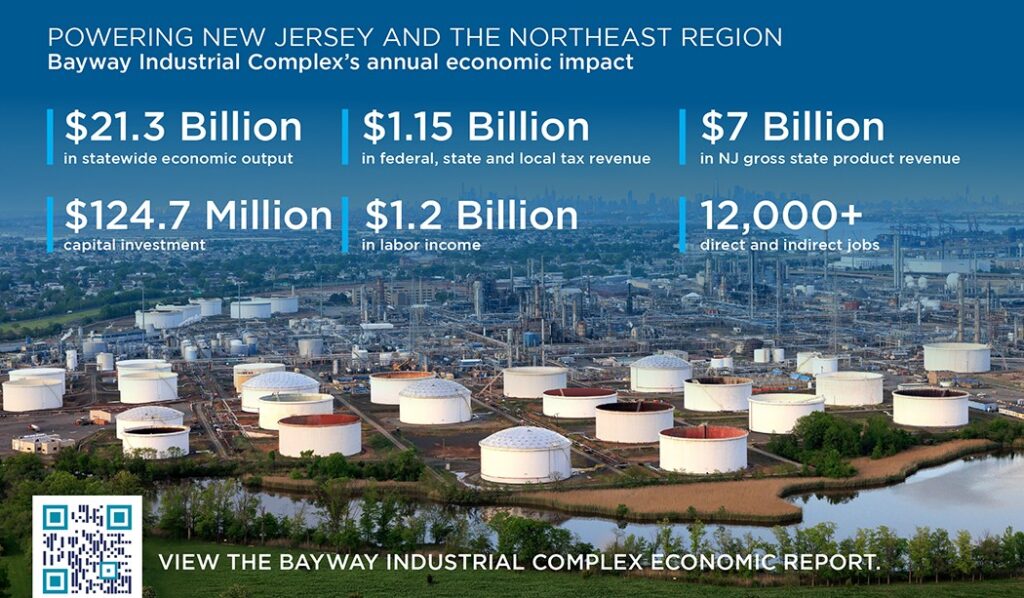
An economic impact analysis by NJBIA and the New Jersey Institute of Technology finds the Bayway Industrial Complex in Linden to be a substantial contributor to New Jersey’s overall economy, generating $21.3 billion in total statewide output, while adding nearly $7 billion to the Gross State Product.
The analysis, prepared by NJIT’s Office of Institutional Effectiveness utilizing the IMPLAN input-output economic model for the year 2023, also shows the Complex supported more than 12,000 jobs in the state in 2023.
The impacts reflect the combined operations of five co-located firms—Phillips 66, Infineum, Nexpera, Linden Cogeneration, and Sunoco—that together span refining, chemical manufacturing, power generation, environmental services, and fuel logistics.
The full report can be found here.
“While non-renewable energy sources and chemical manufacturing sometimes come under ideological attack in the state, what the Bayway Industrial Complex provides is absolutely essential to the state’s economic output, and an unmitigated driver of the regional and local economies,” said NJBIA President and CEO Michele Siekerka.
“As policy choices will directly influence the future trajectory of the Complex, it is imperative that our policymakers appreciate both the investment these companies make, their value and partnership within their immediate community, and the output they wholly provide to the state in terms of revenue and jobs and beyond the state in terms of energy and supply chain.”
“Phillips 66 has been part of the fabric of the City of Linden and Union County, New Jersey, for more than 100 years,” said Bayway Refinery Vice President Don Susanen. “We are incredibly proud of the contributions our people and our products that have supported growth in our community and the state.”
“The Bayway Industrial Complex is a massive economic driver for our state and our region,” said Congressman Tom Kean, Jr. “As we work to strengthen energy security, drive innovation, and expand economic opportunity, Bayway remains central to that mission. I look forward to continuing to build on this progress to demonstrate that New Jersey can and will lead in creating a stronger, more secure energy future that lowers costs for families.”
Other results from the 2023 analysis include:
- 12,091 jobs supported statewide
- $1.2 billion in labor income
- $1.15 billion in tax revenues
- $124 million in capital investment
The study calculates the direct effects (activity at the facility itself: employment, payroll, materials, and capital investment); indirect effects (supply-chain response as contractors, vendors, and service providers expand their operations); induced effects (household spending by workers whose income is supported by the facility) and the total impact (the sum of direct, indirect, and induced effects).
Other notable and multi-level impacts that are shown include:
- Employment and Labor Income: In 2023, the Complex supported more than 12,000 jobs statewide, including 1,600 direct on-site positions and thousands more through supply chains and household spending. These jobs generated approximately $1.2 billion in labor income, underscoring the breadth of the impact on the state’s workforce.
- Economic Output and GSP Contribution: Total economic output linked to the Complex reached $21.3 billion in 2023, with nearly $7.0 billion added to Gross State Product (GSP)—close to 1% of the state’s economy. This level of concentration highlights both the scale of Bayway’s contribution and the extent to which New Jersey’s economy is tied to a single site.
- Supply Chain and Household Linkages: Of the $21.3 billion in output, $4.8 billion came from supplier purchases and $3.2 billion from household spending. These figures illustrate how Bayway’s activity supports a wide range of industries, extending far beyond its core refining, chemical, and power operations.
- Capital Investment and Technology: In 2023, companies at the site invested about $124 million in capital projects, including facility upgrades and environmental technologies such as emissions recovery and hydrogen co-firing. These investments contribute to construction and supplier activity in the short term while shaping longer-term technology adoption and regulatory compliance.
- Public Revenues and Fiscal Stability: The Complex was associated with approximately $1.15 billion in federal, state, and local tax revenues in 2023, including $507 million at the state and local level. This recurring revenue stream makes the site relevant to fiscal planning, as changes in its operations would directly affect public budgets.
- Infrastructure and Energy Supply: The Complex provides more than half of New Jersey’s refining capacity and plays a role in fuel supply for the broader Northeast corridor. Its dependence on pipelines, energy systems, and transportation infrastructure underscores the importance of maintaining resilient infrastructure to support both state and regional energy needs.
“The economic and strategic significance of different industries within the Complex should not be understated,” Siekerka said. “It is also important to recognize the extent of how the operations within the Complex connect international energy supply to local markets, all while providing jobs and wages to thousands of New Jerseyans.
“NJBIA encourages our policymakers to not seek out costly and disruptive burdens for job creators within the Complex. In addition to the employment, labor income and revenues provided by its continued operations, the businesses within it have made investments in new technologies to ensure positive future economic and environmental outcomes.”