
NJBIA’s 2026 Regional Business Climate Analysis Shows NJ Still Worst in Region
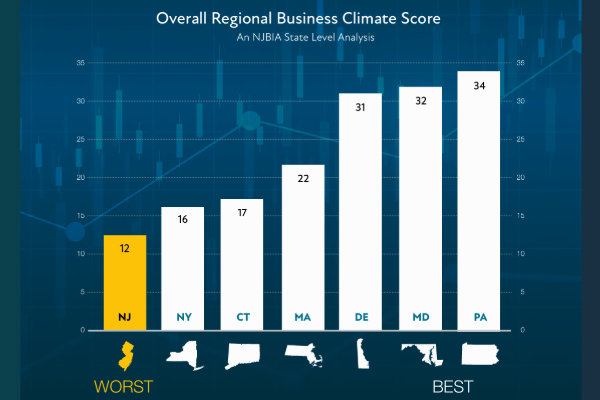
NJBIA’s 2026 Regional Business Climate Analysis, released today, shows New Jersey continues to rank last in the region in cost competitiveness and business taxes for an eighth consecutive year.
The analysis, found here, shows New Jersey remains a regional outlier with the top corporate tax rate (11.5%) and highest property tax paid as a percentage of personal income (4.38%).
Additionally, New Jersey finished with the second highest top income tax rate and combined state sales tax rate.
“As we see some of our larger employers challenged or choosing not to grow in New Jersey, these are often the numbers behind those situations,” said NJBIA President and CEO Michele Siekerka.
“New Jersey continues to have some of the highest tax burdens and costs in the region, and in the nation in some categories. And unfortunately, our lawmakers are still considering bills like the Climate Superfund Act that retroactively and likely unconstitutionally penalize certain lawful companies $50 billion.
“It is this combination of high taxation and extreme burdens that only enhances our unfortunate reputation of being one of the least business-friendly states in the nation,” Siekerka said.
New Jersey’s top corporate rate remains at 11.5%, the highest in the nation, by far, following Gov. Phil Murphy’s about-face two years on a prior commitment to sunset a temporary 2.5% surtax on the state’s largest employers.
Delaware’s 8.70% top corporate rate is a distant second-highest rate in the region, but the First State also has a 0% combined sales tax rate.
Meanwhile, neighboring Pennsylvania’s 7.49% corporate net income tax rate will continue a downward trajectory to 4.99% by 2031.
“These results highlight the serious affordability and regional competitiveness challenges that our job creators face in New Jersey, year in and year out,” said NJBIA Vice President of Government Affairs Althea D. Ford.
“While we are encouraged that there is more awareness of these competitive challenges, New Jersey really does need to either individually or comprehensively reduce our high business cost-drivers.”
“This is why it’s time for a true reform agenda in New Jersey," Siekerka added. “Once budget season ends June 30, it’s time to immediately pivot to a comprehensive process to break down these barriers to job growth. That can only happen through a much-needed proactive reform agenda.”
DATA BREAKDOWN
NJBIA’s annual Regional Business Climate Analysis, this year prepared by Ford and NJBIA Research Analyst Jack Ramirez, scores six individual business cost drivers that measure business competitiveness in seven states.
State rates in each category are scored from 1 (least competitive) to 7 (most competitive).
New Jersey’s overall business climate score was 12 points, making it the least competitive state for the eighth consecutive year.
Pennsylvania, which was third overall three years ago, finished in the top spot for a second straight year with a score of 34.
Maryland (32) and Delaware (31) finished second and third, respectively, followed by Massachusetts (22), Connecticut (17) and New York (16).
New York was the only state with the highest rate in three categories: minimum wage rate ($17), income tax rate (10.90%), and state sales tax rate (8.54%). The Empire State, however, also has the lowest corporate tax rate in the region at 7.25%.
Compared to the six other states, New Jersey has the top property taxes paid as a percentage of income at 4.81%.
In the study, unemployment insurance taxes are represented by the maximum UI contribution per employee, which is calculated by multiplying each state’s taxable wage base and maximum tax rate.
New Jersey did improve in this category, placing third this year. Behind New York’s highest minimum wage rate ($17) are Connecticut ($16.94) and New Jersey ($15.92).
For the fourth straight year, New Jersey’s top income tax rate of 10.75% has been surpassed only by New York’s top rate of 10.9%.
To account for both state and local sales taxes, NJBIA’s sales tax metric combines each state’s statewide sales tax rate with the average of any local sales taxes collected by local governments.
As a result, New Jersey finished with the second-highest combined sales tax rate at 6.6% – a good distance behind New York’s 8.54%.