
IRVINGTON DELIVERS ANOTHER ROUT: VAUSS CRUSHES INMAN AGAIN, SECURES FOURTH TERM IN A POLITICAL LANDSLIDE ERA
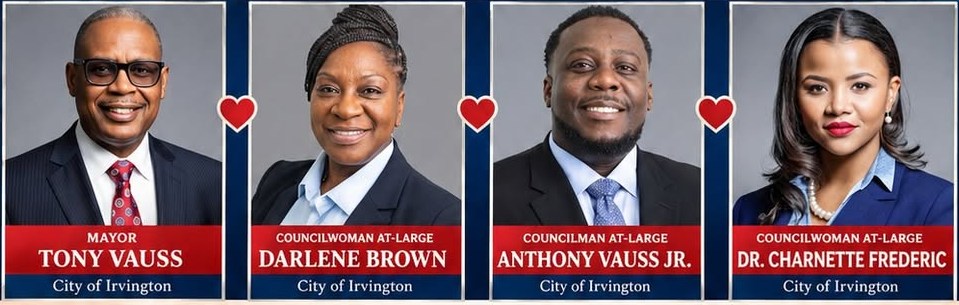
IRVINGTON, N.J. — At this point, it’s no longer a rivalry.
It’s a rout.
Mayor Tony Vauss has once again overwhelmed longtime challenger Paul Inman, winning re-election in 2026 with 67.01% of the vote to Inman’s 32.99%—a 34-point margin that not only secures a historic fourth consecutive term, but reinforces what Irvington voters have now made unmistakably clear over more than a decade:
This is no longer a competitive political environment.
It is a one-sided reality.
And it has been for years.
A RESULT THAT CONFIRMS, NOT SURPRISES
There was no late-night suspense. No dramatic shift. No tightening race.
What happened Tuesday night was not a surprise—it was a confirmation.
Irvington voters did what they have done repeatedly: they returned to the same leadership, by overwhelming margins, without hesitation.
For Mayor Vauss, the victory cements not just longevity, but dominance—four straight terms, each defined not by narrow wins, but by decisive, commanding outcomes.
For Inman, it marks yet another entry in a growing list of losses that are no longer explainable as close calls, bad timing, or shifting political winds.
THE NUMBERS DON’T SUGGEST A CONTEST—THEY SUGGEST A PATTERN
One landslide can happen.
A decade of them tells a different story entirely.
- 2014: Vauss outpaces Inman by over 30 points
- 2018: Vauss runs unopposed
- 2022: Vauss delivers a crushing 60+ point blowout
- 2026: Another decisive 34-point victory
Different elections. Same outcome.
This is not fluctuation.
This is control.
THE MOMENT THAT DEFINED THE GAP
If there was ever a moment that exposed the imbalance, it came in 2022—and it still looms large.
In that race, Paul Inman received 874 votes.
Every single one of his running mates—Yasmina King, Allison Morris, and Durrell Watford—received more votes than he did.
That is not just unusual.
That is politically devastating.
Because the top of a ticket is supposed to lead.
Instead, it lagged.
And four years later, despite another campaign and a new slate, the core issue remains: the numbers still don’t support the candidacy at the top.
TOTAL BALLOT DOMINANCE: A TEAM THAT OUTPERFORMED ACROSS THE BOARD
The separation didn’t stop at the mayor’s race—it extended across the entire ballot.
Vauss-aligned candidates Darlene Brown (24.19%), Anthony A. Vauss Jr. (23.35%), and Dr. Charnette Frederic (22.96%) didn’t just win—they doubled and, in some cases, nearly tripled the support of their opponents, decisively outperforming Ruth Baptiste (11.04%), Durrell Watford (10.41%), and Jude Ogu (8.05%). The margins reflect more than popularity—they point to organizational strength and voter confidence in a unified team. Brown, a 40-year Irvington resident and longtime community leader with deep ties to public safety and neighborhood organizing, brings grounded, hands-on credibility. Anthony Vauss Jr., with years of experience as Chief of Staff and a next-generation leadership profile, represents continuity with energy and institutional knowledge. Dr. Charnette Frederic, a seasoned public servant, scientist, and civic organizer, brings professionalism, global perspective, and a long record of community mobilization. Together, they did not run as individuals—they ran as a cohesive governing force, and voters responded accordingly.
WHY THE VOTERS KEEP COMING BACK
Dominance like this doesn’t happen in a vacuum.
Mayor Vauss has built more than a political base—he’s built a connection.
His decision to publicly share a serious health battle, including a dangerously high A1C level, and turn it into a community-wide message about awareness and prevention, added something politics rarely offers: authenticity.
It made leadership human.
It made it relatable.
And it made it real.
Couple that with consistent visibility—events, outreach, direct engagement—and what you get is something stronger than messaging:
You get trust.
WHEN ELECTIONS STOP BEING COMPETITIONS
Let’s be clear about what these margins mean.
- 10 points = a solid win
- 20 points = control
- 30–60 points, repeatedly = dominance
At that level, voters are no longer weighing choices.
They’ve already made them.
And they keep making them the same way.
THE HARD TRUTH ABOUT THE RIVALRY
Paul Inman has been persistent.
But persistence hasn’t translated into progress.
The margins haven’t narrowed in any meaningful way. The outcomes haven’t shifted. The trajectory hasn’t changed.
At some point, the conversation stops being about effort—and becomes about reality.
And the reality is this:
Irvington voters are not searching for an alternative.
They’ve already chosen their leader.
THE ERA IS NOW UNDENIABLE
Four consecutive terms.
Overwhelming victories.
A decade of sustained electoral dominance.
This is no longer about one election.
This is about an era.
And in Irvington, that era is defined clearly and conclusively:
Tony Vauss is not just winning elections—he’s setting the standard for them.