Advocates Launch Campaign to Stop Towns from Wasting Opioid Settlement Funds, Petition State for Rules on Local Spending
After towns misspent millions, Repair & Care New Jersey calls for state oversight of local spending to ensure funds repair the harms of the overdose crisis and pay for lifesaving care
Photos from Hearing Available Here
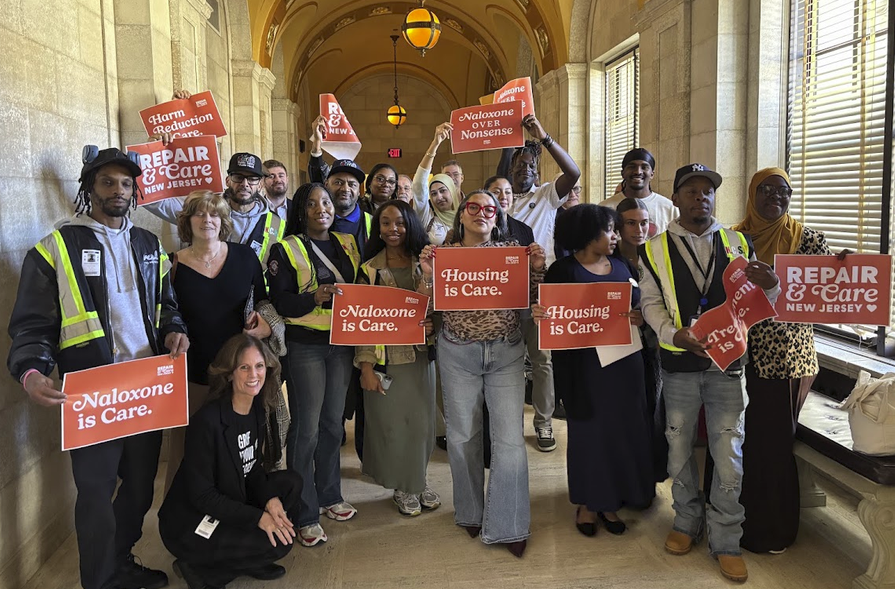
TRENTON, NJ - Harm reduction providers, public health advocates, and families who have lost loved ones to overdose gathered at the New Jersey State House today to call on state officials to set new standards for how towns and counties spend opioid settlement funds, filing a rulemaking petition with the New Jersey Department of Human Services (DHS) to use their existing authority to put those guidelines in place.
The new campaign, Repair & Care New Jersey, launches after local governments wasted millions of settlement dollars on concerts, police equipment, Flock cameras, and other items unrelated to the overdose crisis instead of on the lifesaving services the money was meant for.
“The opioid settlement isn’t a slush fund. This money is supposed to repair the harm of the overdose crisis and care for the people living through it,” said Jenna Mellor, Executive Director of the New Jersey Harm Reduction Coalition and member of the New Jersey Opioid Recovery and Remediation Fund Advisory Council. “Every dollar wasted on a bounce house or Flock camera is a dollar that could have helped keep someone alive. The state has the power to set clear rules for how towns spend this money, so we’re asking our state officials to use it.”
New Jersey is expected to receive more than $1.1 billion in opioid settlement funds through 2038, with funding split in half between the state and local governments. While state spending is guided by a strategic plan that prioritizes evidence-based, lifesaving harm reduction services, housing, and treatment, the state provides no guidance or oversight for local spending.
“This money won’t last forever. We need to make it count and invest in what we know saves lives,” said Arron Wheeler, Lead Outreach Worker at Newark Community Street Team. “Our community-led teams are the real first responders on the frontlines of this crisis. They are on the street every day meeting people where they are, giving out supplies and connecting people to care. That's a big reason why overdose deaths are going down across the state. Every town in New Jersey could be building on that progress, but that’s only going to happen if the state makes sure this money goes where it’s supposed to.”
Last year, the State Comptroller found that Irvington wasted more than $600,000 in settlement funds and concluded that state oversight of local spending was inadequate. A NJ.com investigation found at least 25 towns have exploited settlement funds, spending roughly $2.3 million. Recent filings show that towns are spending funds on DJs, dirt-bike demonstrations, ice cream socials, police canines, attorneys fees, gym gear for cops, and more.
“The system failed my son, and right now it’s failing thousands more people just like him,” said Tonia Ahern, a mother who lost her son Rory to an opioid overdose. “Families like mine are the reason this settlement exists in the first place. I can’t understand how so many towns are misusing these funds, or how the state is just letting them get away with it. The state has to step in and start holding people accountable, because there are a lot of families out there waiting for the help my son never got.”
Overdose deaths in New Jersey have fallen by more than 40 percent since their 2022 peak, a decline state health officials credit to the expansion of harm reduction services. But that progress hasn’t reached every community equally, as Black and Hispanic residents still die from overdoses at far higher rates than white residents. Advocates say settlement funds should close that gap rather than go toward police equipment and other items that do nothing to address it.
“Right now, Black communities are facing some of the deadliest and fastest-growing impacts of the overdose crisis, and they deserve the same access to treatment, housing, and harm reduction that’s driving overdose deaths down everywhere else, " said Racquel Romans-Henry, Policy Director at Salvation and Social Justice. “Opioid settlement funds should be used as a tool for repair and healing, not as another revenue stream for expanding policing. If these dollars are truly intended to address the devastation caused by this crisis, they must be directed toward Black communities and Black-led organizations that have the trust, expertise, and relationships necessary to save lives."
Advocates filed a petition for DHS to adopt a new rule setting binding guidelines for how local governments spend opioid settlement funds. Advocates also asked DHS to formally confirm that state law gives it the authority to oversee local spending. The petition asks DHS to exercise its existing authority to establish spending requirements consistent with the purpose of the settlement funds.
“It’s time for the state to step up and use the authority it already has to help counties and municipalities understand how these funds should be used,” said Bre Azañedo of Reduce Harm, Inc. and a member of the New Jersey Opioid Recovery and Remediation Fund Advisory Council. “We need every dollar to do what it was intended to do: save lives and reduce harm. If spent correctly, these investments can help build and sustain the public health infrastructure that helps keep people alive. New Jersey has an opportunity to lead by showing what it looks like to spend these funds responsibly, with real accountability and transparency to the communities they’re meant to serve.”
Under the proposed rule, local spending would be guided by the same priorities the state follows for its own share: housing, harm reduction, treatment, and wraparound services like transportation and peer support.
The rule would bar spending on entertainment events, police surveillance technology, routine police and government operating costs, and programs with no evidence behind them. Towns would need to document why each expenditure qualifies and file itemized annual reports, and DHS could require towns that misspend funds to return the money to their settlement accounts.
“Ask people in recovery and families who have lost loved ones what they need, and they’ll tell you: safe housing, transportation to treatment, peer support, and someone who won’t give up on them,” said Elizabeth Burke Beaty, Executive Director of Sea Change Recovery Community and Harm Reduction Center. “We know what works, and advocates have already developed a National Roadmap for Opioid Settlement Funds to help communities invest these dollars where they can make a real difference. Yet too many towns ignore guidance, using funds for purposes that don’t address the crisis. New Jersey needs clear state standards to ensure every community uses these dollars responsibly, transparently, and for the people and families most impacted by this epidemic.”
Community-based organizations are also on the front lines of the crisis, working with people who use drugs, connecting residents to services, and responding to overdose in their neighborhoods. Advocates say local spending decisions must reflect the expertise of these communities and prioritize interventions that meet people where they are.
“We see every day in Paterson how much our communities need resources that keep people alive and help them heal,” said Precious Kirby, Director of Community Engagement at Black Lives Matter Paterson. “These dollars are a real opportunity to make a difference, but we can’t take that opportunity for granted. We need to invest in the community-based services people actually need, like harm reduction, treatment, and support for families. The state has to make sure this money is being spent the way it was intended and reaching the communities that have been hardest hit by this crisis.”
The campaign also emphasizes that settlement funds should be treated as a public health resource, guided by evidence, transparency, and the needs of people and communities most affected by the crisis.
Through Repair & Care New Jersey, advocates are calling on DHS to act on the petition and establish enforceable standards for local spending. They are also urging local elected officials to engage people with lived and living experience, harm reduction providers, and affected communities in decisions about how settlement dollars are invested.
The more than $1.1 billion coming to New Jersey represents a rare opportunity to address the overdose crisis and invest in a healthier future. Advocates say the state must ensure that opportunity translates into meaningful action, accountability, and lives saved.
###
Background on the Rulemaking Petition:
Despite recent reports that raise serious concerns over local spending, DHS has publicly stated that local governments are ultimately responsible for ensuring that settlement funds are spent appropriately. Advocates are calling on DHS to use its existing authority under the 2023 Opioid Law to strengthen oversight of local settlement spending through two requests:
-
Petition for rulemaking: to establish enforceable standards for eligible expenditures, documentation, reporting, transparency, and oversight.
-
Request for declaratory ruling: to clarify DHS’s authority to regulate local spending and adopt rules under existing state law.
The proposed regulations that accompany the rulemaking petition would create a consistent framework for local governments while preserving their ability to choose programs that respond to local needs.
The proposed rules would:
-
Define eligible investments. The draft rules identify four broad categories aligned with the state’s opioid settlement strategic plan:
-
Housing: Recovery housing, supportive housing, and Housing First initiatives.
-
Harm reduction services: Naloxone, sterile syringes, drug-checking supplies, harm reduction centers, and mobile outreach.
-
Treatment: Medications for opioid use disorder, low-barrier treatment, expanded treatment capacity, and trauma-informed care.
-
Wraparound services: Transportation, peer support, case management, discharge planning, and connections to housing and employment.
-
-
Prohibit impermissible spending. Proposed restrictions include entertainment and promotional events unrelated to service delivery; law enforcement surveillance and enforcement technology, including automated license plate readers and surveillance cameras; general law enforcement operating costs; general government expenses; and programs lacking an evidence-based or evidence-informed justification. The rules would also prohibit replacing existing public funding or reimbursing past expenditures.
-
Require justification and community input. Local governments would document each expenditure’s purpose, evidence basis, and relationship to community needs and service gaps. Decisions would account for geographic disparities and meaningful input from people with lived experience, families, community organizations, and providers.
-
Create a review process. A proposed Opioid Implementation Unit within DHS would provide guidance and technical assistance. Local governments could seek formal determinations on uncertain expenditures, with a seven-day public comment period and a written DHS decision.
-
Strengthen transparency and enforcement. Local governments would submit annual, itemized reports detailing expenditures, recipients, procurement methods, supporting evidence, and outcomes. DHS would publish annual expenditure classifications and maintain a public website with spending reports, funding information, public comments, and agency determinations. DHS could review spending on its own initiative or in response to public requests. For impermissible expenditures, it could require restoration of funds, corrective action plans, and referrals to the State Comptroller or Attorney General when warranted.