
Analilia Mejia Explains Her Strong Performance Based on a Bold Policy Agenda and Grassroots Campaign Efforts
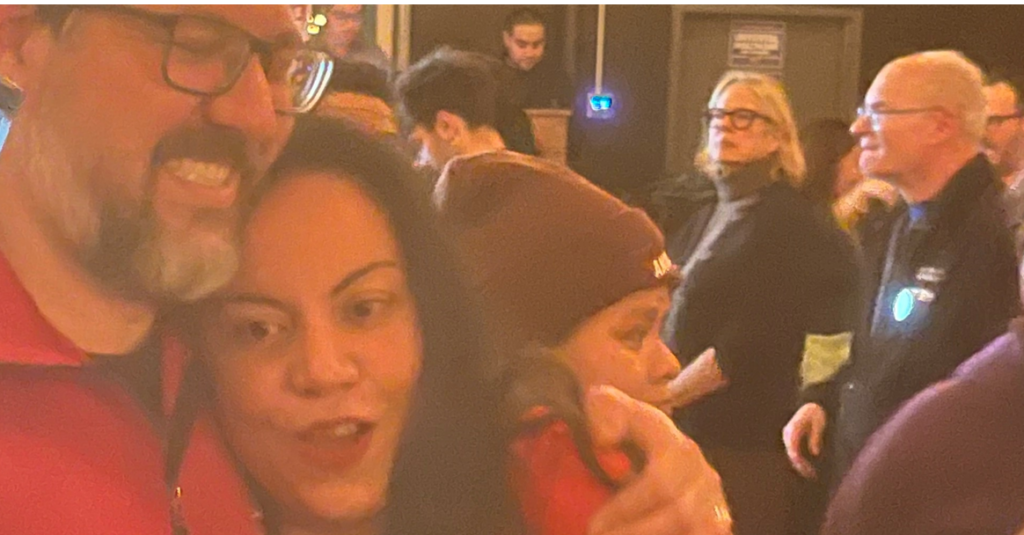
Analilia Mejia Explains Her Strong Performance Based on a Bold Policy Agenda and Grassroots Campaign Efforts
Analilia Mejia breaks down how her campaign resonated with voters, announces endorsement of former opponent Brendan Gill
For the full video of remarks, click here.
Full Transcript of remarks and questions below
MONTCLAIR, NJ — Progressive NJ-11 candidate, Analilia Mejia, delivered post-election night remarks following her strong performance in New Jersey’s 11th Congressional District primary — which finds her leading the field as of Friday morning. She attributed her campaign’s success to an unmatched ground operation and speaking directly to voters concerns about the economy, Trump’s assault on our democracy, and the influence of corporate interests in our politics. Analilia Mejia also announced the endorsement of former opponent and Member of the Essex County Board of County Commissioners, Brendan Gill.
Analilia Mejia currently leads by 486 votes and is expected to see her lead grow as outstanding votes are counted. After multiple outlets called the race before in-person Election Day votes were counted, Mejia surged ahead late last night with strong Election Day support across the district.
“I was going around this district — in Millburn, in Livingston, in Glen Ridge and Montclair and Morristown — speaking about how hard it actually is to be a middle-class family in America, how zip codes do not protect you from rising violent authoritarianism," Analilia Mejia told reporters and supporters this morning. "I said things that maybe your traditional politician wouldn't, but they are the concerns that voters in this district have. I think that made the difference."
Mejia credited her campaign's grassroots organizing approach for connecting with voters who are "tired of the platitudes or the status quo."
“I think there is, across the country, a desire to untether ourselves from corporate lobbyists, big moneyed interests that seem to control both sides of the aisle," said Analilia Mejia. "Our biggest problem is actually the outsized power that big money plays in our democracy and in our government. It impacts our policymaking. It changes how our representatives vote, it changes how they speak during the campaign. And until we send people who are unbought and unbossed by that system, we're not going to have change."
Despite jumping in the race late and starting with just 5% name recognition, Mejia built what she described as "the strongest ground game in this race." Her campaign met commuters at train stations starting at 6:30 AM, knocked doors throughout the district, and hosted town halls that doubled as ICE watch and know-your-rights trainings.
Analilia Mejia was endorsed by Senator Bernie Sanders, Senator Elizabeth Warren, Congresswoman Alexandria Ocasio-Cortez, Congressman Ro Khanna, Congresswoman Pramilla Jayapal, Congressman Greg Casar, Congresswoman Ayanna Pressley, Congressman Maxwell Frost, Congressman Jesús “Chuy” García, Congresswoman Delia Ramirez, the Progressive Caucus PAC, Newark Mayor Ras Baraka, South Orange Village Councilmember Bill Haskins, the Working Families Party, former New Jersey Senate Majority Leader Loretta Weinberg, Minnesota Attorney General Keith Ellison, National Women’s March, Climate Revolution New Jersey, and labor unions representing thousands of New Jersey workers, including CWA District 1, CWA Local 1037, Local 1199 Rutgers AAUP–AFT, the Rutgers Adjunct Faculty Union, SEIU 32BJ, and the SEIU New Jersey State Council.
Full Transcript of the press conference:
Good morning. Good morning.
First of all, I want to thank you for coming out this morning. And frankly, more importantly, I want to thank the voters of New Jersey's 11th Congressional District.
Last night helped show that when you engage people genuinely, when you meet them where they're at, when you have a connection to a community, it resonates with folks. It resonates with voters.
I knew that our race was going to be an uphill battle. The truth is, I jumped in at the end of November. I had to build the plane as I flew it. We knew that because of the uphill battle of having to increase my name recognition, the fact that vote-by-mail ballots were going out at Christmas time meant that many voters were going to be making a decision without having had the opportunity to even know that I was on the ballot and know what my candidacy was about. We would make it up by being on the ground and having the most extensive field operation possible.
That's why you would find me at 6:30 in the morning at some train station somewhere in the district. Thank you to all those commuters who were gracious enough to take my card for the 15th time. And that is why we were proud to have the support of organizations like Make the Road and unions like CWA and SEIU, who we knew were going to hit the ground and introduce me to voters.
[In Spanish]
Buenos días, y gracias. Primero les quiero dar las gracias por estar aquí esta mañana, y más importante, las gracias a los votantes del distrito 11. Creo que señalamos que cuando nos conectamos con los votantes, cuando nos enfocamos en los temas que más están afectando a los votantes—yo empecé esta campaña casi 10 semanas después de muchos de los candidatos. Y la realidad es que como no tenía reconocimiento, mucha gente no conocía mi nombre. Sabía que tenía que proyectar mi mensaje, pero sabía que yo me podía encontrar con los votantes y tocar puertas y hablar con gente y ganar las cosas que importan. Y estoy orgullosa del apoyo que recibí de organizaciones como Make the Road, como los sindicatos, como SEIU y la trinchera de trabajadores. Y estoy contenta que ya vamos a poder tener el apoyo de muchos demócratas, de muchos votantes, y que podremos trabajar con todos los votantes del distrito.
Gracias. Preguntas.
Q&A SECTION
Q: [Question about Latino voters]
A: Bueno, primero yo creo que es importante para todos nosotros familia entendamos que quizás más que muchos otros estados de este país, New Jersey es uno de los estados más diversos. Entonces, mi plan para comunicar con los votantes latinos es igual que con los votantes generales. Lo que está destruyendo este país está perjudicando a todas las familias. La economía no está ayudando a los trabajadores. Las tarifas que este presidente está creando no está perjudicando más. El tema de inmigración, el tema de viviendas, el tema de cuidado único, el tema de cómo pagar por nuestros niños para poder trabajar—todo nos impacta. Más, estamos viendo la manera en que la democracia está peligrosa en este país, y no solo por los republicanos. Entonces, mi enfoque es cómo comunicarme con todos los votantes y asegurar que nosotros podemos hacer el cambio.
Gracias.
Q: How are you feeling right now? Your opponent has already sent a response to this, maybe thinking that you were going to declare victory. Obviously that's not the case, but how are you feeling right now as far as confidence level? Where do you stand? Do you just want to wait for every vote to be counted?
A: I'm an organizer that has dedicated 25 years to increasing civic engagement and to building the kind of community that actually can participate fully in self-governance. As someone who has dedicated themselves—in fact, I have helped write many of the bills that have expanded democracy in New Jersey—here's the bottom line: every vote has to be counted.
But here's the other thing. Here's the other truth. We left everything on the ground. We knocked on as many doors, made tens of thousands, hundreds of thousands of phone calls. We connected with people on a daily basis in genuine ways. I didn't just run town halls or run commercials—I ran trainings. I engaged people on what's happening across our country and what they could do to make change. I know that we resonated with people.
The truth is, as I shared, I jumped into this race later than almost anyone. I had 5% name recognition. I had to build my name recognition, define myself as a candidate, and connect with voters, and I did that effectively.
And so I do think that we have emerged victorious, but I want to first make sure that every voter's voice is heard. But I'm already thinking about how do we consolidate so that we can tackle the bigger issue, which is how do we reclaim democracy in our nation and ensure that the voices of voters in New Jersey's 11th Congressional District are actually heard?
Q: How important do you think your position on ICE was to your performance last night?
A: I think the fact that I was bold and unafraid to speak truth was incredibly important. I think voters feel that they want to have a representative that actually represents them. And you cannot watch what's happening in Minnesota, what happened in Chicago, what happened in California, what happened in Morristown across this district—you can't look at it and not see it for what it is.
We are eliminating due process and equal protection for everyone, not just immigrants. We are violating people's constitutional rights, not just immigrants. ICE is completely overreaching. It's a bloated agency that I believe cannot be reformed. It's only existed for 22 years. It must be replaced by something that isn't violent, that isn't shooting Americans in the streets, that is respecting our Constitution, and that resonated with folks.
So yeah, I think what really mattered was people were choosing a representative that would uplift their voice in DC. And it is clear, just based on how many of the candidates shared my view about defunding, abolishing, tearing down an unjust, clearly unjust and unwieldy and dangerous institution.
Q: Do you think this signifies a progressive shift overall in Jersey?
A: I think that what we are seeing in New Jersey is that for many, many years, we had a county line that made it impossible for candidates to run. For six years when I ran the Working Families Party, I worked with partners across the state to eliminate this problem. This is the first race in which we actually have the kind of open primary, the possibility for new ideas, for better candidates to run. And so that is one thing that we're certainly seeing in New Jersey.
The other thing that we're seeing nationally is what I've said from the beginning: our biggest problem is actually the outsized power that big money plays in our democracy and in our government. It impacts our policymaking. It changes how our representatives vote, it changes how they speak during the campaign. And until we send people who are unbought and unbossed by that system, by that big money, we're not going to have change.
But again, the steps that we have taken to build democracy are paying off.
Q: The biggest money in this race was AIPAC. What role do you think it played in your performance?
A: Immediately, I think the day after we started seeing the ads, we were on a shared forum, and I denounced AIPAC and what they were trying to do in terms of confusing voters and flooding the zone with misinformation, with fear, and with, frankly, just disgusting tactics.
But it is the reason why I was in opposition of taking AIPAC money from the beginning. When I first jumped in and I said we should not take dark money from these big, dark money groups—money or resourcing or support—because they end up corrupting the process. Another big issue we have is Citizens United, right? It is that idea that big money can actually silence voters.
And so I was disgusted that they were going after Tom Malinowski, but I didn't need to see the assaults to know the practices that they employ and to be against it. So in many ways, I'm glad that New Jersey 11 voters got to see the terrible tactics so that we could reject it in the future.
Q: So you think that AIPAC casting Tom as sort of pro-ICE—is that the misinformation that you're talking about? Do you think that misled people as busy voters?
A: I think that they were taking a bit and trying to make it the entire story. And the bottom line truth is that there is no space for those kind of tactics, that outsized money in a real true participatory democracy. It silences people, it confuses voters, and it is actually unfair and actually detrimental to our democracy.
Again, I denounced what happened to Tom, I've denounced what they have done to other candidates across the country, and I'm glad that voters in New Jersey's 11th got to see it in action, and were equally disgusted.
Q: Do you think that helped you?
A: I think what helped me was that I had the strongest ground game in this race. What helped me was that I spent all the time that I could actually talking to voters. I did not go negative, I focused on issues. I made sure that I was speaking to people's daily problems and existence.
[In Spanish] Eso es lo que más impactó. Y la realidad es que gasto de millones y millones de dólares para tratar de silenciar a los votantes, no se pudo en el estado, en este distrito. Y entonces creo que lo que funcionó era trabajar y comunicarse con los votantes.
Gracias.
Q: If you are—it may seem premature to ask, but if you're eventually declared the nominee of the party, do you anticipate being able to—this is an unusually large field, 11 candidates—do you anticipate being able to coalesce the rest of the candidates around you in support so that you can secure the election?
A: Well, this morning I received a very gracious and generous call from Brendan Gill, who said he was excited to support me, and I thanked him because I know that in this moment, Democrats have to join forces to actually tackle the bigger issue.
I'm reaching out to candidates, and even before last night—again, I'm not a politician, I'm an organizer, and that included my fellow candidates. For me, the most important thing is for regular voters to have an opportunity to understand the issues, to make their demands, and for us to represent their voices.
I know that there were many individuals who supported Brendan Gill, Iisha Wade—they ran great campaigns—and I know that their supporters will find a home in Team Analilia for New Jersey, New Jersey's 11th Congressional District.
Why? Because we center people. We center the experiences of voters. Again, I've lived here for 13 years. I'm raising my family here. I know that many residents in New Jersey's 11th Congressional District stretch themselves to be in this district. They're looking for the infrastructure, they're looking for the schools, they're looking for the quality of life. Latino, African American, you name it—we are just trying to raise our families as best we can.
It is a diverse community. It is a welcoming community. And I think I represent exactly who the voters are in New Jersey's 11th.
Q: Beyond your excellent ground game, what do you think most animated voters? What do you think accounts for the large turnout that we saw in this special election?
A: I ran as an organizer, and as an organizer, I know I have to expand the base and grow the voter pool. I know that you have to educate, agitate, and then mobilize people. I knew that I had to ensure that my town halls, my conversations with folks actually left them with more information. That is why I ran town halls that included trainings. It's why I never went negative—because people wanted to understand the issues, not mudslinging. And so that had an impact.
Q: Organizers organize, I grant that, but do you think there's something bigger happening here? Is it anger? Are people sending a message elsewhere, or do you think it's all about you and your candidacy?
A: No, of course. In fact, I keep saying it's about us and not me. It's about how people are experiencing this economy and then wanting to hear their concerns spoken out loud. Folks are tired of the platitudes or the status quo, not hearing the conditions, the issues that really resonate for them.
I think that the fact that I was going around this district—in Millburn, in Livingston, in Glen Ridge and Montclair and Morristown—speaking about how hard it actually is to be a middle-class family in America, how zip codes do not protect you from rising violent authoritarianism. I said things that maybe your traditional politician wouldn't, but they are the concerns that voters in this district have. I think that made the difference.
Now, can I extrapolate that to what's happening nationally? First, I'll say, I know that what happens in Jersey—I kept saying, "What happens in New Jersey won't stay in New Jersey."
I think that there is across the country a desire to untether ourselves from corporate lobbyists, big moneyed interests that seem to control both sides of the aisle. I think that will resonate with voters, whether Republican, Democrat, independent. I think we saw it in New Jersey, I think we will continue to see it through the midterms.
Q: There's obviously a large Jewish community in District 11. What do you say to them who might be concerned about your positions if you are in Congress, but also the potential for backlash after AIPAC spending?
A: What I invite all voters to do is actually to get to know me. See, you can't be a Black woman in America raising Black children and not understand viscerally how othering and racism and anti-Semitism and anti-Blackness are both cut from the same cloth and dangerous.
I have to give my 14-year-old son the talk about how to hold his hands, how to exist in this world, because he's a Black boy. I know that my Jewish brothers and sisters face rising anti-Semitism in this nation, and it puts them and us in danger. I know this personally.
I understand that in a compressed campaign moment, it is very difficult to fully unpack who you are as a human being and as a candidate. But here's my truth: I fight for people's humanity. I believe in the dignity of all people. I uphold the rights of all my brothers and sisters.
So I welcome the opportunity to engage with all communities because the bottom line is, hate is dangerous, hate divides, and hate doesn't serve. And there's no way that a Black woman growing up in America doesn't understand that.
Q: Can you let us know what remains outstanding after last night's election? And then have you allowed yourself to start thinking about—you've got another campaign, election in April, then we go back to the polls in June, and we go back to the polls in November. So presumably, this could be a very long year. Have you allowed yourself to think about your strategy, how you plan to reach as many voters as possible?
A: Again, I'm an organizer, so I know that you have to reverse engineer from your goal. So our goal is to represent the voters and citizens of New Jersey's 11th Congressional District. That means that we have to have a strong plan for how we're going to connect with people, working backwards from November's general election.
Right now, what I'm focused on is making sure that all votes are counted. I'm making sure that my volunteers are thanked because the tremendous work that they put in delivered victories. I want to make sure that I'm connecting with my previous opponents to make sure that we can work together to represent the interests of voters in this congressional district.
And I'm looking forward to spending a little bit of time with my kids and my husband because this was a compressed race. This was a fast sprint. And you know, before I jumped in, I was focused on trying to get Mikie Sherrill elected governor. And before that, I was working on how do we continue to support a message that protected healthcare during a government shutdown.
I'm an organizer that's been working on this for 25 years and so it has been a little relentless pace. I am looking for a little bit of a break, but I know that it's a relay race in some ways, it's a sprint in another, and then it's a marathon.
Q: You have had some very high-profile supporters—Elizabeth Warren, Bernie Sanders, AOC. There was a very interesting article in the New York Times this morning about how the fortunes of Bernie Sanders and AOC have risen now within the party in connection to your performance. How does that make you feel?
A: When I had the opportunity to be Senator Sanders' political director, what I saw firsthand was the power of speaking to people's experiences, and the power of speaking to the "us" and not the "I."
I think Senator Sanders, Congresswoman Ocasio-Cortez, Pramila Jayapal, Ro Khanna, Ayanna Presley, Greg Casar—they all essentially have a common thread, and that is centering the experiences of their constituents, voicing the concerns of the people they represent, and being unbought, unbossed by those lobbyist interests that seem to silence our representatives instead of emboldening them.
[In Spanish] Quiero aclarar en este momento que no se completamente separado el resultado de la elección. Estoy enfocada en cómo vamos a conectarnos con los votantes a través del año, y estoy en comunicación con los compañeros que también corrieron. Algunos ya están dándonos su respaldo, empezando con Brendan Gill. Y trabajando arduamente para asegurar que representemos a nuestro distrito.
CLOSING
Thank you so much. Thank you so much.
[End of press conference]