
McIver Stands Against DOJ Targeting at Oral Arguments in Criminal Case
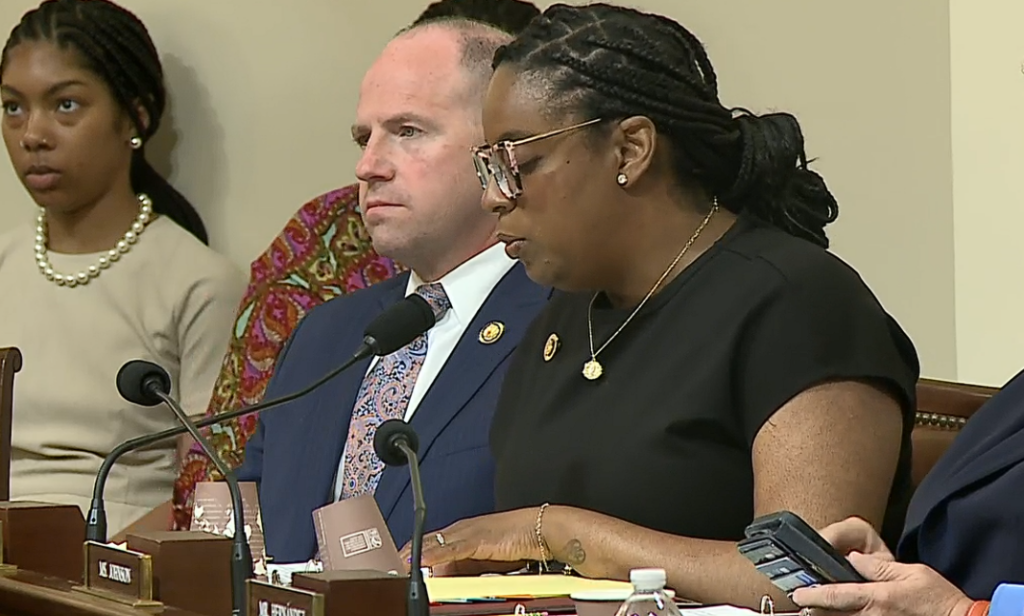
Today, a federal court in Wilmington, Delaware, heard oral argument in the ongoing criminal case against Congresswoman LaMonica McIver (NJ-10) brought by the Trump administration. McIver was present in the courtroom while Judges Thomas Ambro, Stephanos Bibas, and Cindy Chung heard arguments from Paul Fishman, McIver’s Counsel, and Mark Coyne, Assistant U.S. Attorney for New Jersey. The recording of the full argument will be distributed.
The argument covered two of the four pre-trial motions filed by McIver in August 2025—a Motion to Dismiss Based on Selective Enforcement and Prosecution, and Vindictive Prosecution, and a Motion to Dismiss Based on Legislative Immunity. A federal district judge declined to dismiss the case on these grounds in December 2025; McIver noticed her appeal to the Third Circuit shortly thereafter.
The charges stem from a confrontation, instigated by the Department of Homeland Security (DHS) at the Newark detention center, Delaney Hall. The controversy around Delaney Hall has escalated in recent weeks with reports of detainees engaging in a hunger strike to protest mistreatment.
The fact that McIver and the other members of Congress present at Delaney Hall on the day of the incident were, in Fishman’s words at argument, “drawn” outside of the facility by DHS conduct remains a troubling throughline that the government was unable to explain.
McIver was able to appeal the district judge’s ruling pre-trial because the Speech or Debate Clause, which exists to ensure that members of Congress are not chilled in their exercise of legislative authority, protects members from the burden of even having to mount a defense against the virtually unlimited resources of the Department of Justice (DOJ).
In this case, as McIver has noted many times, including in her remarks outside of the courthouse today, the “process is the punishment.” The Speech or Debate Clause should be a bulwark against the DOJ’s efforts to silence dissenting legislative voices.
A transcript of McIver’s remarks can be found below, and a video of McIver’s remarks can be found here. Fishman’s remarks can be found here.
Transcript - remarks to press outside of the J. Caleb Boggs Federal Courthouse today:
McIver: Good morning, everyone. I'm not sure if it's still morning or not, but first of all, thank you all for covering the case. The bottom line is that we are in the second stretch of this fight against the Trump administration, and it is clearly what we said from the beginning: This is about weaponizing the Department of Justice to do their personal bidding against people that they don't like. I'm one of those people on that list for showing up to do exactly what I've been saying that I did: do my job and have oversight.
This case is about protecting members of Congress' ability to do their job on behalf of the constituents that elected them. And so we're going to keep fighting. I feel confident in my attorney's arguments today, and we're looking forward to the decision coming down from the court.
Q: How did you think today's arguments went?
Fishman: I thought the court was very engaged, which is not a surprise for this court. They're all excellent judges, they're very smart, they clearly were very prepared for the argument, and none of that surprises me. And they were doing exactly what judges should do in a case like this, which is asking the lawyers from both sides about the strength of their arguments on particular points. I feel pretty good because they identified the issues that concerned them, and we had really good answers for those things.
Q: What did you think about the arguments from the other side?
Fishman: Well, I've known Mr. Coyne a long time, as you can tell from the argument. I don't think it matters whether Mr. Coyne is a man of great character in this case. This case is not being run in the U.S. Attorney's Office in the District of New Jersey. The decision to deploy ICE for an oversight visit by three members of Congress was made in Washington. The decision to arrest the mayor was made in Washington. The decision to charge my client was made in Washington, and it's very clear that the decisions that are coming out of this department right now, with respect to these kinds of matters, are not to be trusted.
###