
Colleen O'Dea: FDU Poll, Early Voting, Suggest Blue Wave

A new FDU Poll and early in-person voting turnout provide more evidence of a potential blue wave in New Jersey’s congressional elections this year.
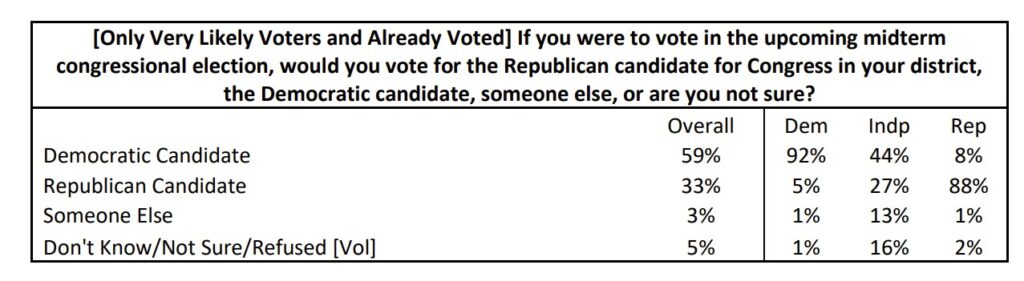
The poll from Fairleigh Dickinson University released today<10/27> found that New Jerseyans who already voted or are very likely to vote favor a generic Democrat over a Republican, 59% to 33%. Democrats won every gender, age, racial, ethnic and educational status breakdown. Democrats also were favored to tackle the most important issues cited by voters: affordability, gas prices, the Iran War, immigration policy and checking the power of President Trump.
“There just isn’t any good news to be found for Republican candidates this cycle,” said Dan Cassino, an FDU professor of government and politics and executive director of the FDU Poll.
That’s true in the early voting numbers, too. In the first two days of early in-person voting, Democrats outvoted Republicans statewide by a more than 2-to-1 margin, roughly 82,000 to 38,000. That’s a far larger gap than in last year’s gubernatorial and state Assembly elections, when 69,000 Democrats and 63,000 Republicans voted in person during the first two days of early voting.
More Democrats cast ballots than Republicans in every district except the 4th along the Shore, which represented by 23-term Republican Chris Smith, who co-holds the title of longest serving member of the U.S. House of Representatives with Kentucky Republican Hal Rogers.
Even more significantly, in the battleground 7th District, where Democrat Rebecca Bennett is trying to unseat Republican incumbent Tom Kean Jr., Democrats cast 49% of ballots, compared with 30% cast by Republicans. And in the 2nd District, where Democrat Zack Mullock is in the middle of what may no longer be such a longshot challenge to Republican incumbent and President Trump ally Jeff Van Drew, Democrats led in votes cast, 45% to 38%. Last year in both those districts, Republican voters had cast thousands more votes than Democrats during the first two early voting days.
There’s no way to know whether all registered partisans voted for the candidates representing their parties. But assuming they did, these early in-person voting numbers, combined with mail-in ballot totals through Sunday, give substantial leads to Democratic congressional candidates in every district at least as of now. In the 2nd, the spread is close to D+25 (29,200 Democratic voters versus 16,000 GOP, or 50% versus 25% of all). In the 7th, it’s nearly D+31 (38,600 Democrats to 17,500 Republicans voting, or 56% to 25%).
So far, more than 610,000 New Jerseyans have voted early by mail or in person, about 10% all registrants. Ultimately, the ballots cast by unaffiliated voters will matter in the final tally. So will the Election Day turnout next Tuesday, which may strongly favor Republicans.
But the FDU poll makes clear that the electorate is unhappy with many of Trump’s policies and these are on voters’ minds as they consider which party to support in the midterms.
“President Trump has made himself the face of the Republican Party, and not many Republicans have dared to push back. So it makes sense that as Trump becomes less popular, Republican candidates are going to go down with him,” Cassino said.
He said one reason Republican candidates are suffering is a drop in the number of people who consider themselves “MAGA,” the most loyal Trump supporters. In January 2024, 27% of voters -- or two-thirds of Republicans -- considered themselves MAGA. That proportion dropped to 16% last March and 10% in the latest survey.
“We’d expect there to be more MAGA voters during the run-up to a Presidential election in 2024,” said Cassino. “But a drop from 16 percent to 10 percent in just six months is remarkable, and shows how toxic the MAGA brand has become, even among Republicans.”
The fact that the greatest numbers of voters said that affordability and gas prices were the top issues -- 90% and 87% respectively called these important -- also hurt Republicans in the poll. When asked about these issues, and about providing a check to Trump’s power, before being asked which party’s candidate they would choose, voters preferred Democrats by wide margins: affordability yielded a 27-percent lead for a Democratic candidate, gas prices D+26 and checking Trump’s power D+25. Republican candidates fared a little better on other issues, but those polled still chose Democrats when asked about the Iran War (D+22), the status of transgender people (D+19) and immigration (D+16).
“Not only does thinking about affordability make voters more likely to support Democrats in the midterms, it makes people more likely to vote in the first place,” said Cassino. “Republicans desperately need to reframe the race around their issues if they want to get competitive, but it may just be too late.”
The FDU Poll’s general margin of error is +/-3.4 points.