
Governor Mikie Sherrill Issues Six Executive Orders on Day One
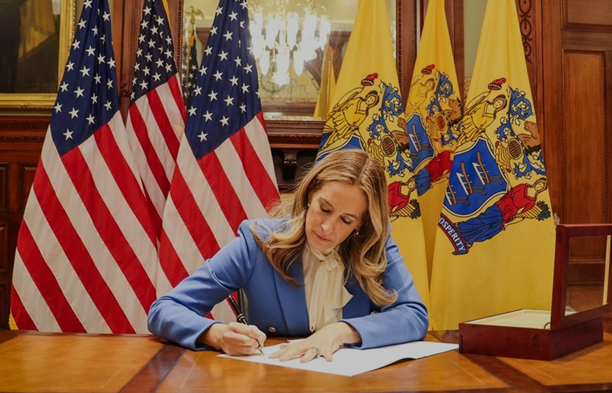
Governor Mikie Sherrill today hit the ground running on her first day in office – taking historic executive action to lower costs, protect our kids, and make Trenton more accountable and effective for the people of New Jersey. At the swearing in ceremony in Newark, she signed two executive orders following through on her promise to declare a State of Emergency on Utility Costs on Day One. At the State House in Trenton, Governor Sherrill signed additional executive orders to save New Jerseyans time and money, improve kids’ online safety and mental health, and strengthen trust in state government.
“In the Navy, I learned that you have to lead, follow, or get out of the way – and I promised the people of New Jersey that I would be on a mission to deliver starting Day One. That’s why I’m beginning my term as governor by taking immediate action to deliver on some of the key issues impacting New Jerseyans. My first six executive orders include freezing utility rate hikes, ensuring that officers and staff in my administration are meeting the highest standards of transparency and accountability, bringing agencies together to protect our kids online, and cutting through the roadblocks and red tape that are making it too hard to do business here. Let’s get to work,” said Governor Mikie Sherrill.
Each executive order is summarized below, with full text linked:
Executive Order No. 1
This executive order uses state authority to offset upcoming rate increases due to the regional grid operator PJM’s mismanagement and hold utilities accountable for keeping rates from continuing to climb at an unsustainable rate.
- Uses existing funds to offset electricity bill increases coming in June.
- Empowers the Board of Public Utilities (BPU) to pause or modify utility actions that could further increase bills.
- Directs BPU to review utility business models to ensure alignment with delivering cost reductions to ratepayers.
Executive Order No. 2
This executive order declares a State of Emergency under the Disaster Control Act and creates and expands multiple, expedited state programs to develop massive amounts of new power generation in New Jersey, because more power means lower costs – and we must move quickly as the federal government cuts support for energy production. It also tackles permitting challenges at the state level and interconnection delays at the utility level that hold up projects and drive up costs.
- Initiates and accelerates programs to bring on thousands of megawatts of new solar and battery storage generation.
- Directs state agencies to identify permit reforms to more rapidly deploy new energy projects.
- Directs BPU to take action on artificial intelligence “ghost loads” by requiring electric utilities to report on energy requests from data centers.
- Establishes a Nuclear Power Task Force to position the state to lead on building new nuclear power generation.
Executive Order No. 3
This executive order establishes the ethical standards to be followed by public employees and officers serving in the Sherrill administration, creating a culture of accountability and strengthening trust in state government.
- Continues the personal financial disclosure statement requirements for designated public employees and officers.
- Continues the provision for establishment of a blind trust for certain public employees and officers.
- Continues the disclosure of a public employee or officer's interests in closely held corporations or other business entities.
- Continues the Code of Conduct applicable to the Governor and Lieutenant Governor.
Executive Order No. 4
This executive order establishes the Office of the Chief Operating Officer (COO) within the Office of the Governor – a position designed to drive efficiency, transparency, and accountability across state government. The order outlines key roles and responsibilities of the COO, as well as the structure of the Office and how state agencies will interact with the Office of the COO. Previously, Governor Sherrill announced that Kellie Doucette would be New Jersey’s first COO.
- Establishes the roles and responsibilities of the COO, including to serve as the Governor's principal advisor on strategic initiatives, operational performance, and organizational effectiveness and to lead the Governor’s efforts to improve customer service and streamline permitting and regulatory processes across agencies.
- Establishes the overall structure of the Office of the COO, including an Office of Strategic Initiatives & Economic Opportunity to support the implementation of the Governor’s strategic priorities and an Operational Performance Office to improve processes and effectiveness across government.
- Establishes other roles within the Office of the COO focused on Cabinet affairs, constituent relations, administration, and Governor’s office operations.
- Requires state agencies to designate liaisons to coordinate with the Office of the COO.
Executive Order No. 5
Following through on her Save You Time and Money Agenda, this executive order takes action to reduce permitting delays and costs, boost accountability in the permitting and regulatory process, and expand transparency into how taxpayer dollars are spent.
- Establishes a Cross-Agency Permitting Team, within the Office of the Chief Operating Officer, to streamline and expedite the state permitting process to reduce project delays and costs and to improve customer service, transparency, and accountability for permit applicants.
- Requires state agencies to catalog all the types of permits they issue and submit this information to the Cross-Agency Permitting Team.
- Directs the Cross-Agency Permitting Team to develop a Permitting Dashboard that displays the status and progress of state permit applications for projects in New Jersey and permitting process timeframes (“shot clocks”) that reduce permitting review and approval delays.
- Establishes a Regulatory Simplification Team, within the Office of the Chief Operating Officer, to reform state regulatory structures and processes to reduce project delays and costs.
- Creates the New Jersey Report Card, an interactive public-facing online portal that provides information on state-funded programs and what they are delivering for residents and includes an interactive budget analysis tool.
Executive Order No. 6
This executive order takes action to protect kids online and improve children’s mental health. It creates a new office within the Department of Health to coordinate whole-of-government efforts to keep kids safe online and directs all state agencies with jurisdiction over issues pertaining to children and their interaction with technology platforms to prioritize children’s mental health outcomes.
- Orders relevant agencies to prioritize children’s mental health outcomes and conduct ongoing stakeholder engagement with kids, parents, educators, and mental health professionals to inform their efforts.
- Requires agencies to review their existing policies and regulatory frameworks to identify opportunities to promote healthy internet and social media use.
- Tasks the COO with coordinating with agencies on this matter.
- Establishes the Office of Youth Online Mental Health Safety and Awareness in the Department of Health to coordinate with state agencies and generate policy proposals to improve children’s safety.
- Underscores the governor’s commitment to creating a higher education-based research center focused on online safety and youth mental health.